The Road to China's Future Revolution — Program Document of the Proletarian Liberation Struggle Association

Originally published at: 中国未来革命的道路 – 曙光

The Road to China’s Future Revolution (Third Edition Second Draft).pdf (3.5 MB)

22 Likes

The Road of China’s Future Revolution

The Association for the Liberation Struggle of the Proletariat (LSEP)

Written by FenghuoFlame

2023427

Philosophers have only interpreted the world in different ways; the point, however, is to change the world.

------ Karl Marx

Marxism is not a dead dogma, not a doctrine that never changes, but a living guide to action.

------ Vladimir Lenin

The theories of Marx, Engels, Lenin, and Stalin are theories that are “universally applicable.” We should not regard their theories as dogma, but as a guide to action. We should not merely study the words and phrases of Marxism-Leninism; we should study it as a science of revolution. We should not only understand the conclusions these men—Marx, Engels, Lenin, and Stalin—drew from their broad study of real life and revolutionary experience concerning general laws, but also learn the standpoint and methods they used to observe and solve problems.

------Mao Zedong

I. Changes in the World Situation

It has been 47 years since China’s capitalist restoration in 1976. Since the failure of the Chinese revolution, the international communist movement has fallen into a low ebb. With the disappearance of the socialist powerhouse—China—from the world stage, the newly emerging revolutionary Marxist parties and national liberation forces in various countries suffered heavy setbacks. A large number of revolutionary parties quickly took the road of revisionism, and the comprador forces in the colonies and semi-colonies, with the support of imperialists, came back again. Reactionary forces were rampant; the imperialists rejoiced and congratulated one another. They thought socialism had been completely destroyed, that the “general crisis” stage of capitalist society had passed, and that bourgeois dictatorship could henceforth stand “as firm as Mount Tai.”

In these 47 years, with the disappearance of the socialist camp, imperialism reestablished its rule in the Third World, gaining vast overseas commodity markets, rich sources of raw materials, and cheap labor. Through economic means, imperialism restored the colonial territories it had once ruled; by using capital export and unequal exchange it seized huge monopoly profits, thereby greatly easing the extremely sharp domestic class contradictions during the period of general crisis. The disappearance of the socialist camp and the sudden strengthening of the imperialist camp dealt an incalculable blow to the national liberation movements of the peoples of the Third World. This “middle zone” between socialism and imperialism became a fierce battlefield where the peoples of colonies and semi-colonies directly confronted the imperialist blocs, and they were forced to suffer temporary defeat after losing strong external support. Thus, the contradiction between imperialist countries and the vast oppressed nations of the colonies and semi-colonies was also temporarily eased in favor of the imperialist bloc. And because of the sudden collapse of the socialist camp and the Soviet revisionist imperialist bloc, the imperialist powers acquired in a short time a large amount of world spheres of influence to be repartitioned, thereby temporarily easing the contradiction among imperialist countries over the demand to redraw the world “according to strength.”

“But the people cannot be exterminated, revolution cannot be extinguished, and communists cannot be frightened! They rise from underground, wipe the blood from their bodies, and bury the bodies of their comrades. Then they continue to fight!” After such a catastrophe as the collapse of socialist China, many revolutionary parties collapsed under pressure from internal revisionists and external imperialism. Yet there remained a group of Marxist-Leninist-Maoist parties richest in revolutionary spirit, fighting on the front lines of revolution. In India, revolutionaries have persisted in revolutionary struggle since the 1960s. After nearly half a century of defeat, struggle, and testing, they finally overcame the problems of sectarianism and parliamentarism, founded the Communist Party of India (Maoist) at the beginning of the 21st century, and have since continued armed struggle against the reactionary Indian government. In Latin America’s revolutionary wave, the most prominent force, the Communist Party of Peru, through applying Chairman Mao’s revolutionary theory—especially the “three magic weapons” [①] to the Peruvian revolution, also raised high the banner of the Latin American national democratic revolution and continues to fight to this day.

The easing of the three great contradictions in the imperialist era [②] can only be temporary. The “general crisis” of capitalism has not yet passed, because regression of the movement does not accord with the dialectic of historical development. [③]

“The coming of a new revolution, like the coming of a new crisis, is inevitable.” [④]

First, the contradictions within the imperialist countries continue to develop. The socialization of production has advanced tremendously, but production and capital are highly concentrated, and the contradiction between socialized production and capitalist private ownership is becoming ever more acute. Socialized production requires more organized coordination among sectors and departments, but under capitalism the socialization of production only intensifies competition and the anarchy of production, because the bourgeoisie’s nature of producing for profit does not change.[⑤] For example, in recent years, the state economic pandemicization [⑥] practiced by imperialist China during economic crises has enabled a large number of medical testing enterprises, medical equipment manufacturers, and pharmaceutical companies to make huge profits, while small and medium-sized capital has gone bankrupt at an astonishing rate and masses of workers have fallen into unemployment.[⑦]

Second, the contradiction between oppressed nations and the imperialist countries continues to develop. In pursuit of higher profits, the bourgeoisie of imperialist countries has intensified economic aggression against the peoples of the Third World. In particular, barbaric imperialist China has for three consecutive years become the world’s largest exporter of capital by annual flow, carrying out a frenzy of capital export to Third World countries, especially Black Africa.[⑧] In order to suppress the resistance of oppressed nations, the United Nations, having become a tool for imperialist powers to partition the world, established the notorious “United Nations Peacekeeping Force” (peacekeepers) specifically to maintain the colonial order of the imperialist countries. Flying the rotten banner of “preventing armed conflict and safeguarding world peace,” imperialism in fact dispatches troops to various Third World countries to suppress national resistance movements and protect its own economic colonial interests. From the enormous expenses imperialist blocs spend to maintain colonial order, one can infer the heroic struggles of oppressed nations; in the fiscal year from July 1, 2019 to June 30, 2020 alone, the UN’s so-called “approved budget for peacekeeping operations” reached as high as 6.5 billion US dollars! That was more than twice the UN’s 2020 regular budget (3.074 billion US dollars)! [⑨]

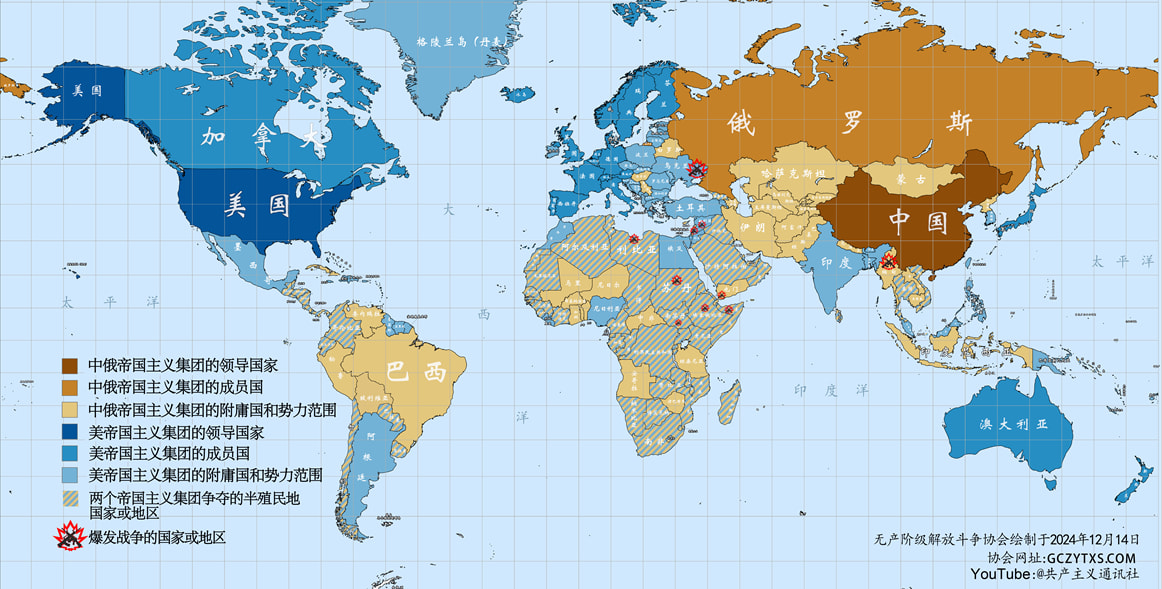
Finally, the contradictions among the imperialist countries themselves have clearly intensified. The Russia-Ukraine war, as a global focal point, and the rivalry behind it between the two major imperialist blocs of Europe and the United States on one side, and China and Russia on the other, have already shown that the contradictions among imperialist states are becoming increasingly acute. Intertwined with the other two great contradictions, they have seriously deepened the crises of the various imperialist countries.

Because of the anarchy of production under capitalism, the development of enterprises, sectors, and even states is uneven, and uneven economic development inevitably leads to uneven political development. In the imperialist era, the role of the law of uneven political and economic development is greatly strengthened. Its obvious manifestations are: newly emerging imperialist countries can use the power of monopoly organizations to establish an advantage in new sectors in a short period of time; while old imperialist countries, due to the accumulation of capital in many old enterprises and sectors, cannot massively renew fixed capital, and because of huge capital exports to the colonies, production at home becomes stagnant. As a result, development among imperialist countries becomes “leap-like,” and the strength of newer imperialist countries can rapidly surpass that of some old imperialist powers. This inevitably leads to an outbreak of contradiction between the existing strength of imperialist countries and the original partition of world spheres of influence. Newly rising imperialist countries demand “a place in the sun,” thereby provoking wars among imperialists.

Today’s imperialist China is a typical newly rising imperialist country. In the more than forty years since capitalism was restored in China, the first twenty-plus years were spent with the ruling class undermining the socialist system and selling itself to old imperialist countries in order to absorb foreign capital, while the latter twenty years (20022022) were the process of rising to become a new imperialist power. If ten years ago the question of whether China was an imperialist country was still quite debatable, then if there are still “Marxists” today who think China is not an imperialist country, they should simply go back and read Lenin’s Imperialism. China today has undoubtedly completed its transformation into an imperialist country, and is already the world’s second strongest imperialist power.[⑩] The rise to power of the reactionary Xi Jinping clique, just like that of the old Brezhnev clique, declared China’s status as an imperialist country. He openly used “becoming strong” to describe the changes in China during his tenure, and used “realizing the great rejuvenation of the Chinese nation” and “building a community of shared future for mankind” to proclaim his ambition to dominate the world. From 2002 to 2022, Chinese imperialism achieved a reversal over the United States in the strength of monopoly enterprises; the number of Fortune Global 500 companies rose from 11 to 145, not only surpassing US imperialism in number, but also in total operating revenue. Over these twenty years, Chinese imperialism also frantically exported capital to the Third World, building its own economic colonies. As of the end of 2022, China’s foreign direct investment stock had reached 2.93 trillion US dollars, ranking third in the world, nearly one hundred times the level of twenty years earlier! Since Xi came to power, imperialist China has announced a series of plans for external expansion and the assembling of new imperialist blocs, including the “Belt and Road,” the “Asian Infrastructure Investment Bank,” “China-Africa cooperation,” strengthening the “BRICS” system, and expanding the “Shanghai Cooperation Organization,” among others. Chinese imperialism’s blatant ambition to expand its sphere of influence internationally naturally aroused the vigilance and fury of US imperialism. Thus on the world stage there unfolded a fierce struggle between two imperialist blocs led by China and the United States. This change in the international situation can be clearly felt from the series of blows the United States has dealt China since the Trump administration came to power in 2016: a comprehensive economic trade war, political efforts to curry favor with Taiwan and escalate the “South China Sea issue,” and military warning provocations against China [⑪].

The facts above clearly show that the “general crisis” stage of capitalism has not yet passed. With historical development, the various contradictions of the imperialist era have once again become clearly exposed. Lenin said: “Imperialism is the eve of socialist revolution” [⑫]. The imperialist era is the era of proletarian revolution; proletarian revolution in this era is directly a question of practical action. And the various disasters created by imperialism in the present day more urgently require us Marxists to shoulder our historical mission at once and reduce the suffering caused in the process of social historical development by the reactionary classes’ rule obstructing social progress.

The world partitioned by the two imperialist blocs

II. The Present Condition of Chinese Society

In imperialist China, a barbaric country where the ruling class directly exercises a fascist system, the condition of the broad masses of workers is extremely miserable. In the more than forty years since China’s capitalist restoration, with the efforts of hundreds of millions of workers laboring long hours day and night under overload, social wealth has grown significantly. But at the same time, the gulf between the bourgeoisie and the proletariat has widened and deepened day by day. The essence of accumulation in capitalist society is “at one pole accumulation of wealth, and at the opposite pole, accumulation of misery, agony of toil, slavery, ignorance, brutality, mental degradation, at the opposite pole, accumulation of misery, toil, slavery, ignorance, brutality, mental degradation, at the opposite pole, accumulation of misery, toil, slavery, ignorance, brutality, mental degradation…” [13] According to data published in the China Statistical Yearbook 2022 by the National Bureau of Statistics of China, 1.22 billion people in China have monthly incomes below 5,000 yuan, accounting for about 86.7% of the total population.[14] Yet according to the 2022 statistics of China International Capital Corporation Limited, the top 1% of China’s population actually owns 36.7% of the nation’s total wealth, while 1.3 billion people own only 3.79% of the nation’s total wealth. Under capitalism, proletarian impoverishment is manifested not only in relative impoverishment—the ever-widening gap between proletariat and bourgeoisie—but also in absolute impoverishment, in the absolute deterioration of the proletariat’s living conditions. According to Premier Li Keqiang’s own admission in 2020, “There are 600 million people whose monthly income is only 1,000 yuan” [15]. Under the pressure of inflation and rising taxes, the cost of living borne by the people keeps increasing without end. This figure can be said to show the shocking poverty of the majority of Chinese workers.

The massive existence of unemployed people further deepens the poverty of the broad masses of workers. According to the data released by the National Development and Reform Commission on January 30, 2023, citing the National Bureau of Statistics, the urban surveyed unemployment rate in December 2022 was 5.5%, and the surveyed unemployment rate for urban youth labor aged 16 to 24 reached as high as 16.7%! This is still data based on our trust in the National Bureau of Statistics of China, and it does not even include the semi-employed population, which accounts for about one quarter of our total labor force! What is laughable is that the Chinese official government has given the semi-employed population a pleasant name—“flexible employment population”—and claims that this is the “future development trend,” a form of employment “loved by young people” and offering job seekers more rich choices. So-called “flexible employment” and “flexible labor use” are nothing but methods that make it more favorable for capitalists to intensify exploitation, while leaving workers unable to make a living because of “insufficient labor.” When the market is prosperous and sales are smooth, capitalists increase the “flexible employment population” to increase the use of labor power; when the market is sluggish and sales are difficult, capitalists massively cut the low-cost “flexible employment population” so that the supply of labor power fits their needs. In China, this is a state of bourgeois dictatorship in which the judicial organs in actual judicial practice protect capitalist interests while workers lack legal knowledge and the strength to struggle. As a result, large numbers of capitalists use “human resources companies” (dog middlemen) to operate under the so-called “flexible labor use” model, reducing labor costs and evading legal responsibility. This has become rampant. According to the Blue Book China Flexible Employment Development Report (2022) released by the Flexible Employment Research Group of Renmin University of China and others, 61.14% of Chinese enterprises were using the “flexible employment” model in 2021. According to the principles of Marxist political economy, low actual wages for workers will force them, in order to obtain wages sufficient to sustain their survival, to prolong working hours, increase labor intensity, and expend more labor. In this situation, even if the number of laborers remains unchanged, labor supply increases. The increase in labor supply makes the oversupply in the labor market even more serious, which in turn causes further unemployment and forced “competition” among employed workers [16]. Further unemployment and “competition” among workers will in turn drive already low wages even lower, forcing workers to lengthen working hours again… and thus a vicious cycle keeps chaining together, and workers’ conditions only worsen. The increase in unemployed people, aside from lowering the wage level and working conditions of employed workers for the reasons above, also forces employed workers to shoulder the living expenses of their unemployed relatives and friends, further worsening the poverty of all laboring people.

In addition to lower wages and deteriorating labor conditions, the constant increase in state taxes is also accelerating the growing impoverishment of the laboring people. Bourgeois vulgar economists claim that taxation is “a form in which the state participates in the distribution of social product in order to obtain fiscal revenue to meet social needs,” and they also claim that the principle of taxation is “taken from the people and used for the people.” But this is not the case, because the state is nothing but the “organ of class rule, an organ for the oppression of one class by another”[17], and the bourgeois state is a tool by which the bourgeoisie oppresses the proletariat. Therefore, taxation in bourgeois states is essentially nothing but the means by which the ruling bourgeoisie supports the “economic basis of the machinery of government and not of any other thing”[18]; from an economic point of view, “the source of taxation is the labor of the nation”[19]. It is merely a special form of surplus value received by the bourgeois state. As noted above, in capitalist society taxation is a means by which the ruling bourgeoisie, through the state, plunders the fruits of labor from the working people to maintain the operation of its own state machine and suppress the people. Thus any increase in taxation actually means increased persecution of workers, using the workers’ own strength to forge the weapons used to suppress them. For Marxists, the significance of studying taxation lies only in analyzing to what extent the ruling class uses this exploitation to strengthen its repressive power and how they carry out this exploitation.[20] According to the National Bureau of Statistics’ own data, in the past twenty years (2002-2022), China’s total tax revenue increased from 1.76 trillion yuan to 16.6 trillion yuan, an increase of 9.4 times! The average annual growth rate of tax revenue reached 11.8%, far exceeding the average annual GDP growth rate of 8.1% during this period, and even more so compared with the growth rate of the actual incomes of the working people.[21] The Chinese government is very adept at using crafty methods to invisibly increase the tax burden. The Chinese official government has repeatedly announced policies to raise the threshold for personal income tax, in order to deceive the working people as if their tax burden had been reduced; in fact, the opposite is true! The usual method of the Chinese government is to increase the tax burden in the process of commodity circulation, ultimately making the broad mass of consumers—working people—pay the bill. And in China, where 86.7% of the population has a monthly income below 5,000 yuan, personal income tax simply cannot be used to represent the actual tax burden on working people! According to statistics released by Guolian Securities Research Institute in 2014, China’s tax revenue distribution was: turnover tax (commodity tax) 52.95%, property tax 26.72%, other taxes 20.33%. The sinister intention of the crafty Chinese fascist government to exploit the Chinese people hidden through commodity taxation is obvious! In this situation, the bourgeoisie, in order to obtain profits, will transfer the tax burden by lowering wages or raising prices (usually both). Moreover, the Chinese government often adopts large-scale tax and fee reduction policies to reduce the direct tax burden of capitalists, making all too clear which class government it is. According to the report published at a January 2021 press conference by the State Taxation Administration under the Chinese fascist government, “The Tax Revenue Collected by the National Taxation Departments in 2020,” during the 13th Five-Year Plan period (2016-2020), tax revenue nationwide reached 65.7 trillion yuan over five years, an increase of 18.5 trillion yuan compared with the 12th Five-Year Plan period! Meanwhile, the estimated total of new tax and fee cuts nationwide during the 12th Five-Year Plan period exceeded 7.6 trillion yuan! Tax revenue increased significantly, yet the capitalists’ burdens were greatly reduced—so who exactly is bearing this heavy “state obligation”? The answer is self-evident.

The extreme deterioration of housing conditions is also a serious problem in Chinese capitalist society. The high concentration of production under capitalism and the distorted distribution of industries inevitably lead to irrational population concentration. This causes urban population and the expansion of city scale to reach astonishing levels, and an abnormal concentration of population forms in cities and districts where labor demand is concentrated. As Marx said: “The greater the concentration of the means of production, the greater must be the corresponding concentration of the labourers in the same space; hence, the more rapid the capitalist accumulation, the more miserable is the state of the labourer’s dwelling.” [22] China’s housing prices, like its commodity prices, are far above the actual income level of the broad masses of workers. Chinese workers on the one hand bear heavy housing expenses, and on the other must endure terrible living conditions. According to statistical data from recent years, the principal balance of personal housing loans per household is 370,500 yuan; calculated with a 25-year repayment period and market mortgage interest rates, the total principal and interest balance per household is about 646,500 yuan<sup><span lang="EN-US"><sup><span lang="EN-US">23</span></span></sup></span> The life of the Chinese people is like a fierce battle: just after winning a little victory in the “struggle” over daily necessities consumption, they suffer a major defeat in the “struggle” over housing consumption, and must use their pitiful remaining savings to pay for their house. Chinese workers live frugally, yet still cannot escape becoming the financial slaves of the big bourgeoisie. While some among the suffering masses are reduced to financial slaves by buying property, others are driven into the most overcrowded corners of the worst residential areas. Workers struggling to survive in major cities are either forced to live in suburban areas far from their workplaces, or packed into partitioned rooms in a unit building in the city. In one industrial city in Guangdong, the monthly rent for a 20-square-meter single room in a “slum” complex is seven or eight hundred yuan. The corridors there are very narrow, the rooms have no decoration whatsoever, the bathroom is an unhygienic, dark, and damp “combined bath and toilet,” and the whole room is an ideal breeding ground for parasites; living there for a week will inevitably lead to skin disease. The monthly rent of seven or eight hundred yuan may seem cheap, but the monthly wage of service-industry workers in that city is mostly only around 3,000 yuan (single day off, 12-hour work system). Workers endure a disaster-like living environment and yet receive no more wage surplus. The Chinese government often promotes that “happiness comes from struggle,” while the hardest-working laboring people live in an infernal environment, sustaining themselves by consuming adulterated, low-quality food. This is truly a merciless satire on official propaganda.

Under capitalism, the impoverishment of the broad masses of peasants is even more serious than that of urban workers. In China, the extreme backwardness of agricultural production and the extreme deterioration of peasants’ living conditions have reached astonishing levels.

During the period of socialist China, from 1949 to 1971, the population increased from 542 million to 852 million, with an average annual growth rate of 2.1%; while grain production increased from 216.2 billion jin to 492 billion jin, with an average annual growth rate of about 4%[24], meaning grain output grew at nearly twice the speed of population growth! During the socialist period, China’s grain production not only met domestic self-sufficiency but even had a slight surplus for export. But in imperialist China, due to the restoration of capitalism, the people’s communes that carried out collective agricultural production suffered catastrophic destruction, and agriculture regressed to the small-peasant production of the feudal era; large tracts of land were abandoned because bankrupt peasants had to seek other livelihoods, while the bourgeoisie was unwilling to operate agriculture because capital turnover in the sector was slow and profits low, and agricultural production suffered severe regression. Today, imperialist China’s food self-sufficiency rate has fallen to 65.8%, and the self-sufficiency rate of soybeans is less than 17%!**[25 ] China must import large quantities of soybeans from the United States and Brazil every year in order to maintain normal consumption.

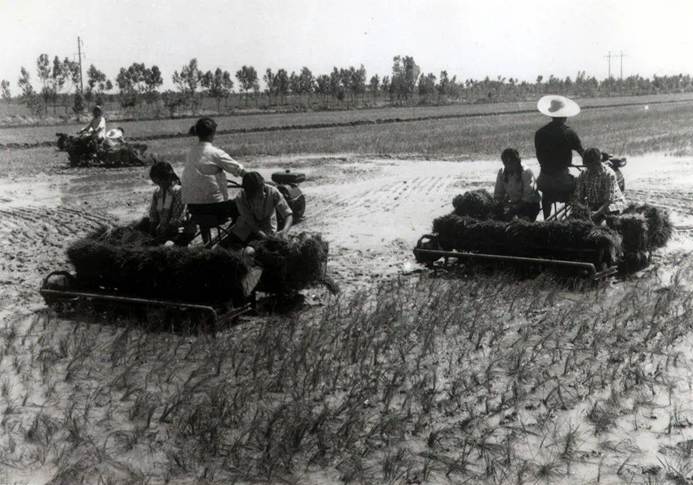
A rice transplanter being used by the original seed farm in Huojia County, Xinxiang City, Henan Province

Because agriculture is the pillar of the national economy, agricultural development is the basis for the emergence and development of other sectors, and the development of a socialist country cannot build its agricultural foundation on the plunder of other countries. Socialist China once devoted considerable effort to organizing Chinese peasants to transform the countryside and initially realized agricultural mechanization!

“Compared with 1965, in 1973 our rural electricity consumption had increased 2.8 times; the amount of chemical fertilizer applied had increased nearly 1.9 times; the number of tractors (combined units) had increased 2.2 times, the number of hand tractors had increased 74.8 times, and the actual area of machine plowing had expanded by about 70%; power drainage and irrigation machinery had also increased 2.8 times. More than 90% of counties nationwide had agricultural machinery repair and manufacturing plants.”[26]

The American left-wing progressive Han Ding, who once participated in the socialist construction of China, recorded in his work—The Great Reversal—the enormous changes capitalism’s restoration brought to Chinese agriculture and the Chinese countryside.

In the summer of 1983, I flew from Beijing to Shanghai. At an altitude of 30,000 feet, I looked down, and for the first time I saw the astonishing changes that “the household responsibility system” [27] had brought to the vast North China Plain.

I looked downward, more and more unable to believe my own eyes, and tears could not help but flow. In the past, between villages and the roads connecting them, there were neat square and rectangular plots of land—green, yellow, brown—stretching all the way to the horizon. But now, tiny scattered patches of land were arranged in loose and chaotic shapes, spreading for thousands of kilometers. This was not the so-called “stamp-sized patches” of land before land reform; they were even smaller—like strips, like noodles! Those plots were so narrow that when a horse cart passed, one wheel would be in this person’s land and the other wheel would run over another person’s land.

Chinese peasants once had such a scale of production and such an agricultural system that they might, to some extent, have entered modern society more or less in step with their urban brethren armed with high-tech mechanization. But in the end it became like this! Like a tiny flash on a fluorescent screen, the large-scale production that once existed, the system that once existed, just disappeared. In the scroll of history, this new page had just been opened, yet it immediately retreated a thousand pages and returned to the starting point at once.

What a heartbreaking change! Chinese peasants once devoted immense effort to building our socialist motherland, but in the end it all came to nothing, and apart from the Chinese fascist government’s worthless “red-letter documents” and the 60-yuan monthly subsidy for rural elderly people, the peasants had nothing left.

“In my view, small plots of land like noodles can only lead to a dead end. I cannot imagine that in any place in the world, a small peasant owning only small plots of land could have any long-term hope, and of course they are not the Chinese peasants today, who have only one or two mu of scattered land everywhere. [28]

Truly “thirty years of hard work, and overnight back before liberation!”[29]**

The barbaric pursuit of profit by the bourgeoisie has led to serious destruction and pollution of the natural environment. The extreme weather since the summer of 2022 has made the capitalist system’s harmful impact on the environment clearer than any data could. Starting in mid-June 2022, temperatures nationwide rose sharply; the average daily temperature exceeded 30℃ across the country, and regions where the daily maximum exceeded 40℃ were not uncommon. Such extreme heat led the Central Meteorological Observatory to issue the first-ever red high-temperature warning in history. At the same time, during the entire summer of 2022, the Yangtze River basin experienced continued abnormal heat together with severe drought, producing the abnormal phenomenon of “flood season turning dry.” The Yangtze River ceased flowing, and Dongting Lake and Poyang Lake dried up one after another, exposing the lakebeds. This is truly a terrifying sight never before heard of in Chinese history! The extreme heat and low rainfall led to frequent forest fires, the most serious of which was the Chongqing mountain fire that broke out on August 17. After the fire erupted, within just two days it evolved into a large-scale fire continuing simultaneously in many parts of Chongqing. The “system superiority” that the Chinese revisionist government usually boasted of completely failed at that time, and after a week the fire still had not been effectively brought under control. In the end, the flames were extinguished only after the volunteer masses in Chongqing spontaneously organized firefighting activities and fought bravely. Typhoon activity in the summer of 2022 was also unusually rampant. From June to October, China and surrounding areas were hit by 19 typhoons, averaging 4 typhoon events per month! Among them, super typhoon “Meihua” actually moved northward and made landfall in Liaoning Province in Northeast China, setting the record for the northernmost autumn typhoon landfall since 1949<sup><span lang="EN-US"><sup><span lang="EN-US">30</span></span></sup></span>

In the face of China’s extreme weather, the main victims are the working class and the broad masses of poor people, while the bourgeoisie can completely retreat to scenic suburbs and summer resorts, and even continue their “aristocratic sport”—golf—at the expense of the environment. Beijing, as a densely populated city short on water, has more than 130 golf courses! Among them, more than 60 golf courses consume as much as 40 million tons of water per year<sup><span lang="EN-US"><sup><span lang="EN-US">31</span></span></sup></span> Based on Beijing’s average monthly water use of 8 cubic meters per three-person household (96 cubic meters per year), this could supply water for more than one million people<sup><span lang="EN-US"><sup><span lang="EN-US">32</span></span></sup></span> This single pastime enjoyed by the capitalist gentlemen alone has drained the groundwater of Beijing and Hebei, while the construction of golf courses itself requires opening up large suburban areas and consuming vast resources and manpower for maintenance, greatly damaging Beijing’s natural environment. The destruction of the environment caused by bourgeois luxury and profit-driven operation is nonetheless borne by the broad masses of the people. Beijing has become the nationally famous “capital of sandstorms,” and the sand-and-dust scene that blocks out the sun has become a common “spectacle” of Beijing. Not only that, but since this year the range of sandstorm effects has expanded to a shocking degree: half of China, from Inner Mongolia in the north to Hubei and Zhejiang in the south, is covered by sand and dust. This is yet another national record created by the contemporary bourgeoisie!

The all-around decay of politics and economics in Chinese imperialism has caused the complete degeneration of Chinese society’s ideology [33] and cultural life! In this imperialist China, which claims to be “prosperous, democratic, civilized, harmonious,” thugs and bandits run wild, drug abuse and alcohol abuse are rampant, books, newspapers, and films preach lust and theft, and social morals are rotten beyond measure. On China’s various internet platforms and social media, pornographic, violent, and vulgar content is endless; the decadent thoughts of bourgeois individualism and hedonism spread throughout society!

In the ideology of Chinese society, the two biggest tumors are Confucian thought and subculture [34] culture.

Confucian thought is a hierarchical ideology that plays a hugely reactionary role in Chinese society. Its core doctrine is “ruler and subject, father and son, husband and wife”[35], that is, it demands that the ruling class in society possess absolute power over the ruled class, that the head of the family have absolute power over family members, and that the husband have absolute power over the wife. Today the reactionary ruling class in China goes to every length to exculpate Confucianism, trying to cover up the core of Confucian hierarchical thought and portray it as a supposedly class-transcending doctrine of moral norms.

Certain ideas arise from certain economic foundations. Confucianism’s doctrine of “order among the young and old, and distinction between the noble and the humble” aims to maintain the stability of private ownership and property inheritance relations in a private-property society.[36]

Feudal patriarchs naturally regard the children they have spent energy and money raising as their own property, and therefore demand unlimited ownership and control over this private property. This is the economic root of China’s deformed feudal patriarchal ideology. “The bourgeoisie has torn away from the family relation its sentimental veil, and has reduced that relation to a mere money relation.”[37] Since the patriarch of a private-property family regards children as part of his own property, he naturally wants to obtain the greatest possible return from this property. Therefore, under the pretext of “thinking about the children’s future,” they do everything possible to intensify oppression of their children, hoping that the stock in hand can rise to a high price. If we do not take Chinese feudal patriarchs for foolish simpletons, then the fact that most schools engage in deformed militarized management of students, and that institutions such as “electroshock anti-internet-addiction schools” and “Yuzhang Academy” have appeared as “educational institutions” that abuse students, can only be seen as the result of the tacit approval or even support of most parents. For the school is nothing but a seller of service commodities; what it sells is the service of increasing the value of the “child stock” in the parents’ hands, and the form in which this service tortures the children ultimately depends on the buyer’s needs. In this way, it is not difficult to understand the complex relationship among parents, children (students), and schools. Why a certain man would stab his own son to death with a samurai sword, and why institutions like Yuzhang Academy never seem to be brought down, is nothing but because the parents are “angry that iron won’t become steel.”

In the capitalist society with Chinese characteristics dominated by Confucian thought, the oppression suffered by women is even more severe. The private property system of capitalism with Chinese characteristics is highly fused with the patrilineal system of blood inheritance. Men, as heirs of private-property families and the main source of income, possess dominance in the family and society, arbitrarily dominating and demanding from women who can only degenerate into domestic slaves. Thus there arises in the entire capitalist society, from family and clan to workplace and social life, comprehensive discrimination and oppression against women.

From the economic relations within the family, the property-owning class values inheritance relations most highly. So-called “three forms of unfilial conduct, of which having no heir is the greatest,” and within the private-property family under the present patrilineal system [38], sons are the only descendants with inheritance rights and are the hope of maintaining or even expanding the private family property in the future. Women not only cannot inherit property, but after marriage must become slaves to another family. Therefore, women in private-property families can only be treated as short-term investment tools by feudal patriarchs; when the daughter’s marriage age arrives, the patriarch sells her off as a commodity in one lump sum to recover the “investment cost” of raising her. This is the root of the so-called “bride price” phenomenon.

From the social economic relations, women are affected by menstruation, pregnancy, childbirth, and other physiological activities, reducing the time they can engage in social activity; and because of the constraints of reactionary feudal family concepts, women must bear most of the duties of childrearing and housework. Therefore, from the standpoint of the use-value of labor-power as a commodity, women’s labor power has various “deficiencies” compared with men’s labor power from the capitalist’s point of view, and thus various forms of discrimination against women naturally arise in the capitalist production process. From differential treatment of women in the workplace to their exclusion from various social sectors, women are pushed out of the labor market in capitalist society. And the exclusion of women from social production sectors will undoubtedly further weaken women’s economic status, inevitably increasing their burden of housework, making women stupid, ignorant, and spiritually empty in simple and narrow domestic labor, which in turn deepens their enslaved status.

The Chinese government is accustomed to using all kinds of spiritual opium to numb the people’s consciousness of struggle. Because women suffer especially severe oppression, the dose of opium injected into them by capitalist society is especially large. Today, Chinese society in all ideological fields is in practice promoting the Confucian female standard of “the three obediences and four virtues.” Various family-ethics TV dramas spread Confucian family concepts, advocating the reactionary feudal family mentality of “order among the young and old” and “harmony in the family brings prosperity”; romance idol dramas promote ideas that enslave women, creating the image of so-called beautiful women as “delicate and soft,” “fair-skinned and beautiful,” essentially rationalizing capitalist society’s oppression of women and instilling in women the standards of a qualified slave—female virtue as “dainty, refined womanhood,” female appearance as “fair skin and beauty”—so that women become self-satisfied with being good servants; works that extol individualism and heroism, as well as yellow trash that revels in vulgar sexual desire, also influence women no less than men; and there are all kinds of film and television works that manufacture the petty-bourgeois pursuit of an allegedly “easy, comfortable” pastoral life. These literary and artistic works, carrying reactionary ideology, serve as important external factors that corrupt women’s thinking and immerse them in the myriad enjoyments manufactured by capitalism. Among them, bourgeois aesthetics and vase-ornament thinking [39] are the most poisonous to contemporary women. Many women exhaust all manner of makeup, dressing up, and even cosmetic medicine and plastic surgery to “become beautiful,” not knowing that this is in fact a kind of servant mentality. The pioneer of the Chinese women’s liberation movement—comrade Xiang Jingyu—exposed the truth of women’s love of adornment as early as a hundred years ago. It turned out that after human society entered the patrilineal clan period, men replaced women in production, while women economically degenerated into family slaves, “Thus ‘marriage’ and ‘prostitution’ became the only means of a woman’s life, and the beauty or ugliness of her appearance often determined her entire fate.”[40]** Since women can survive only as family slaves and childbearing tools for men**, then “the lessons of actual life, the results of long training, have gradually universalized the psychology of women’s love of adornment.”[41]**

In the course of the continuous development of capitalism with Chinese characteristics, capitalist private relations and the Confucian thought reflecting these relations developed together. Under the reactionary hierarchical ideology of Confucianism, contemporary Chinese society is filled with oppression of children by parents, of women by men, and of the exploited by the exploiters. Yet China, wrapped in the shell of a “land of propriety and righteousness,” is in fact the most barbaric country in the world! In order to guarantee the stability of capitalist exploitation relations built upon modern slavery, the bourgeoisie must ensure the stability of the feudal patriarchal system and patrilineal inheritance system that sustain this system. Therefore they inevitably have to throw out all kinds of theories beautifying reactionary Confucianism, and the Chinese fascist government hysterically shouts about reviving “excellent traditional Chinese culture.”** China’s government, when explaining the relation between their social system and Confucian culture, says: “Excellent traditional Chinese culture is the fertile soil rooted in socialism with Chinese characteristics.” In doing so, they shamelessly admit that the deformed capitalist system with Chinese characteristics is built upon the rule of this deformed Confucian thought.

The impoverishment of the broad masses of workers, the intensifying unemployment situation, the increasing tax burden, the extreme deterioration of housing conditions, the enormous destruction of the natural environment, and the overall decadence of social and cultural life—all these are serious problems caused by the capitalist system. Capitalism is our disaster! China’s capitalist system has seriously threatened the survival of the Chinese people! The era of imperialism is the era of proletarian revolution. The time has come for us to engage in a decisive battle against capitalism, the final exploiting system in human society. Either capitalism dies, or humanity dies!

III. Problems of the Current Movement

The people’s blood-and-tears history of more than forty years since China’s capitalist restoration has proven that all theories of “peacefully growing into socialism”[42] are lies. What the bourgeoisie calls the “pain of reform” is in fact the permanent suffering of billions under capitalism. Within the bounds of capitalist society, socialist relations of production cannot arise [43]. To fundamentally solve the problem of the capitalist system, only violent revolution that overthrows the bourgeois state and establishes a state of proletarian dictatorship can do it.

The socialist revolution is different from all forms of revolution in the past. In the past, revolutions merely replaced an old form of exploitation with a new one; the socialist revolution seeks to eliminate the final exploiting system in human history. “This is the final struggle!”[44]

“The socialist revolution marks the end of the history of class society of exploiters over thousands of years, marks the liberation of society from all forms of oppression, marks the beginning of an era of true friendship and equality among people, permanent peace in the world, and the complete normalization of human society. The great all-human content of proletarian revolution lies here. It is the most important dividing line in the development of humanity.”[45]

To make revolution, one must analyze society on the basis of scientific theory, estimate the strength of each class and their relations with one another, and clarify the nature, object, path, and prospects of the revolution. No one will trust an organization that does not solemnly put forward a scientific plan and a reliable program; organizations whose programs are stuffed with shallow ideas plucked from personal experience will only provoke ridicule from others.

China is an imperialist country under the dictatorship of the bureaucratic monopoly bourgeoisie. Chinese society is an independent monopoly capitalist society in which capitalist relations have matured, and there are no remnants of feudal relations. These conditions determine the nature of the Chinese revolution: it is a socialist revolution that directly strikes at the capitalist system without going through any intermediate stage and establishes a socialist system on this basis.[46]

China’s ruling class is the bourgeoisie, and the bureaucratic monopoly bourgeoisie occupies an absolutely dominant position within it. Although there are certain contradictions between the private bourgeoisie and the bureaucratic monopoly bourgeoisie, fundamentally the former is an attached stratum dependent on the latter. The private bourgeoisie in Chinese society occupies an economically weak and politically powerless position, which determines its weakness. The private bourgeoisie is also tied by countless threads to the bureaucratic monopoly bourgeoisie; the former needs to rely on the latter in order to obtain favorable economic conditions, which determines its reactionary nature. In China, where fascist autocracy is unprecedentedly severe, private capital depends on bureaucratic monopoly capital and stands together with it on the hostile front against the proletariat. The former uses China’s political and legal system to realize high-intensity and long-term exploitation of the working class, and also depends heavily on the violence machine of the Chinese fascist government to suppress proletarian resistance.[47] With the expansion of Chinese imperialism’s overseas capital export, the private bourgeoisie has also relied on the power of Chinese imperialism to reap astonishing excess profits abroad.[48] The Chinese private bourgeoisie’s characteristics of weakness and reaction make it impossible for it to oppose the rule of the bureaucratic monopoly bourgeoisie; at most it wants a few reforms favorable to them within the capitalist system with Chinese characteristics. These conditions determine that the target of the Chinese revolution is the entire bourgeoisie, with the bureaucratic monopoly bourgeoisie as the main and strongest enemy. The private bourgeoisie is a reactionary class dependent on the bureaucratic monopoly bourgeoisie and is likewise an implacable enemy of proletarian revolution.

According to Lenin’s law of uneven political and economic development of capitalism in the imperialist stage, one can derive Lenin’s other famous conclusion—“Socialism may first triumph in one or several countries”—because the uneven political and economic development among countries in the imperialist era inevitably leads to wars for the repartition of the world, and world war will weaken the imperialist camp, making it possible for the proletariat to break through the weakest links of imperialism. The uneven political and economic development among countries in the imperialist era inevitably leads to uneven development in the objective and subjective conditions for proletarian revolution. The so-called weak link of imperialism refers to the country in the imperialist camp where, due to this law of unevenness, political crisis is deepest, the ruling class is most decayed and incompetent, and revolution is most likely to break out. In this way, we reject a metaphysical understanding of revolutionary situations. The “weakest link” in the imperialist camp is not necessarily the country with the largest proportion of proletarians, the most advanced industrial level, or the highest cultural level of the working class. The weak link of imperialism is the country with the deepest political and economic crisis, the most correct line of the Marxist party, and the strongest revolutionary force based on the worker-peasant alliance.

Imperialist China is precisely the country in the imperialist camp where the contradictions are the most complex and profound, and under the rule of the Chinese fascist government these contradictions are becoming increasingly difficult to suppress and are intensifying day by day. After all, a fascist regime does not signify the strength of the bourgeoisie, but proves its own weakness and tendency toward destruction; “it should be seen as a manifestation of bourgeois weakness”[49]. In China, the contradictions between the proletariat and the bureaucratic monopoly bourgeoisie, private bourgeoisie, and fascist government; the contradictions between the broad rural semi-proletariat and impoverished petty bourgeoisie and the entire bourgeoisie; the contradictions between the national minorities within the country and the Han oppression regime; the contradictions between Chinese imperialism and the broad oppressed colonial and semi-colonial peoples; and the contradictions between Chinese imperialism and the European-American imperialist bloc are all especially sharp and intense. It can be said that Chinese imperialism is the convergence point of all imperialist contradictions.

China is not only a convergence point of imperialist contradictions, but also conceals within it the revolutionary force that can solve all these contradictions. By the end of 2018, the number of industrial workers in China reached 146.4 million[50]; the degree of concentration of industrial workers is also high. According to statistics, in January-February 2022, the average number of employees of industrial enterprises above designated size nationwide was 73.088 million[51], which means that nearly half of the workers are concentrated in enterprises with capital of more than 20 million yuan. The Chinese working class suffers cruel oppression and exploitation by the bourgeoisie and the Chinese fascist government, with extremely low wages, very long hours, extremely poor labor conditions, and no political rights at all. Among all imperialist countries in the world, the Chinese working class has the lowest wage level and the least political freedom, and therefore the Chinese working class is the most revolutionary class among all the imperialist countries in the world.

Since the restoration of capitalism in China, the workers’ movement has also gone through a stage of repeated setbacks and revival. After the Huairentang coup[52], the central power was overthrown by counterrevolutionaries, and the working class, having lost unified leadership, still demanded to fight. They continued to organize struggle across the country, spread Marxism-Leninism among workers and peasants, and tried to resist the restorationist forces through armed uprising. After fierce struggle, the counterrevolutionary ringleader Deng Xiaoping used the seized central power, under the guise of “clearing out the three kinds of people” and “severe crackdown,” to carry out a “great purge” of the revolutionary forces and conscious workers nationwide, temporarily striking down the workers’ movement. After the massive restructuring of state-owned enterprises and the wave of “mass layoffs” in the 1990s, workers again launched new struggle movements. But because the revolutionaries had been purged, workers could not organize effectively, and they adopted many passive forms of struggle such as petitions, hunger strikes, and suicide. After the 21st century, with the establishment of the State-Owned Assets Supervision and Administration Commission, the Chinese fascist government dealt an even greater blow to workers in state-owned enterprises, and the working class could no longer endure such barbaric oppression, launching large-scale strike struggles. In the Tonggang incident of 2009, workers formed a march of seven to eight thousand people, and with the masses joining along the way, the march grew to tens of thousands. Because Tonggang’s newly appointed general manager Chen Guojun behaved arrogantly during the movement, insulting workers and threatening to fire those who participated, he was beaten to death on the spot by the workers. In recent years, China has completed its transition into an imperialist country, the degree of concentration of production and capital has greatly increased, monopoly has reached unprecedented levels, and the poverty of the laboring people has accordingly deepened greatly. Driven by increasingly acute class contradictions, the workers’ struggle has also entered a new stage. In 2018, tower-crane drivers launched a nationwide strike, breaking for the first time the fragmentation of the Chinese workers’ movement that had lasted for decades and greatly raising the consciousness and organizational capacity of the working class. Since then, workers’ movements in China have become even more frequent and intense; strikes in electronics factories and pharmaceutical factories have occurred repeatedly, and even workers in the emerging “tertiary industry” [53] have joined strike struggles. Couriers, food delivery workers, and ride-hailing drivers have also joined the ranks of frequent strike struggle. Strike struggles and mass movements have become so frequent that the Chinese fascist government is no longer even able to keep up with blocking the news of these struggles.

In summary, the huge and increasingly combative industrial working class in China is a powerful revolutionary force, and around it there are also the workers of the “tertiary industry” and the rural laborers, two revolutionary allies whose living conditions are extremely deteriorated. It can be seen that imperialist China is not only a country that gathers all the contradictions of imperialism, but also the country with the strongest revolutionary force based on the worker-peasant alliance. Therefore, the prospects for the Chinese revolution are infinitely broad. The possibility of development in things is determined by the contradictions contained within them; the prospects of the Chinese revolution are contained in the contradictions existing in Chinese society. “Just as a plant is contained within a seed.”[54] Since China has so many complex and profound contradictions, it determines that the Chinese people must make revolution! Since China possesses such powerful revolutionary forces, it determines that the Chinese people’s revolution is bound to win! The future of the Chinese revolution is bound to achieve a great victory of socialist revolution, creating a powerful socialist state in the world, thereby opening up a powerful socialist camp and burying the imperialist robbers of the world forever!

According to the three conditions described above that produce an imperialist “weak link,” China lacks only the final one: an organized Marxist party led by the correct line. From this, it follows that the main contradiction currently existing in the Chinese revolution is the contradiction between the rapidly growing spontaneous revolutionary forces of the masses and the severe backwardness of revolutionary intellectuals and revolutionary organization development. Marxist philosophy is a revolutionary philosophy that unifies worldview and methodology. This main contradiction of the Chinese revolution determines that our urgent task is to build a united team of revolutionary intellectuals through theoretical struggle, and on this basis to establish a Marxist party. The road of China’s future revolution can only be the road toward this goal; it can only be the road to solving the urgent problems in our movement.

At the beginning of the 20th century, the communist movement in Russia also encountered a situation similar to China’s present one: “The working masses have already been greatly agitated by the dark phenomena of Russian life, but we are not good at gathering together all the drops and streams of the people’s righteous indignation.”[55] Lenin pointed out that the most urgent problem of the Russian revolution at that time was that the consciousness of revolutionary intellectuals lagged behind the spontaneity of the mass movement, and revolutionary intellectuals had too low a level of theoretical training and were complacent, not understanding the need to abandon spontaneity and awaken the working class.

In his famous 1902 work What Is To Be Done?, Lenin described the situation of students participating in the workers’ movement in Russia at the time: the students did not contact the old activists at all, nor did they contact other student groups; they did not organize the various parts of revolutionary work, and they went to establish contact with workers and carry out propaganda and agitation without any plan. As a result, they often suffered complete annihilation at the very start of the movement and could preserve not a single organization. Lenin called this behavior “revolutionary craftwork,” describing these students as “like peasants who take up a single stick to go into battle.”[56]

In response to the above situation, Lenin sharply criticized the permissiveness toward spontaneity and the disorganized, unplanned “revolutionary craftwork,” emphasized the extreme importance of theoretical work, and pointed out that the work of revolutionary theorists is to carry out political exposure and help the masses learn to understand the interests and interrelations of the various classes in political events from the standpoint of historical materialism. On the other hand, the revolutionary press should be used as “scaffolding” to build the grand structure of the revolutionary organization, so that planned and organized work can be carried out and the political awareness of all strata of the masses can be awakened.

But the Russian Economists, instead, accused Lenin of being a “theorist,” saying that Lenin’s criticism of their neglect of theoretical questions went “beyond the limits of politeness”[57]. They slandered Lenin as “overstating the role of ‘ideas’ in the movement,” and maintained that “the material factor of the movement and the material environment… determine the path of the movement,” “and theorists, no matter how excellent the theory and program they may hold, no matter how great their efforts, cannot make the movement depart from such a path.”

In today’s so-called “leftist circles” in China, most of the “leftists” [58] look down on theoretical work just like the Economists, or excuse their own degeneration into spontaneity by appealing to their identity as “the masses.” Aside from their habit of being ignorant, the bourgeois individualism of these groups is especially expressed as sectarianism or anarchism: the former is the result of petty intellectuals dividing camps according to personal affinity in order to satisfy vanity; the latter is the reflection in organization of petty-bourgeois freedom and looseness, their rejection of all theoretical and organizational authority. Like two branches joined to one trunk, sectarians and anarchists are united in their ignorance. They treat the “group” merely as their own interest club and play with Marxism as a fashionable hobby.

“The spontaneous path of the movement is the path of the bourgeoisie,” and the condition of today’s various Chinese “Marxist groups” is the most concrete proof of this. Because “the bourgeois ideological system has a much longer history than the socialist ideological system; it has undergone far more thorough processing, and its means of dissemination are incomparable in number.”[59]** Not to mention that most members of the “Marxist groups” are property-owning classes, whose spontaneous movement will bear even more bourgeois marks because of the ideas of their own class. The content of those “groups’” activities is nothing more than making a few sarcastic comments about the Chinese government in an affectation of irony, then digging out fragments of socialist writings for very superficial interpretation; even worse, they discuss games, animation, pornography, and all kinds of low tastes, looking entirely like reactionary gangster clubs. They only know how to shift responsibility with words like “the revolutionary situation is not present,” comforting themselves that they are at least doing some kind of activity, and pinning all hope on waiting for spontaneous mass movements that may happen at some unknown time. Once a serious organization appears that studies Marxism earnestly and demands ideological struggle, they will shout that this is “bourgeois elitism” or “bureaucratism.” Especially when Marxist theory requires criticism of bourgeois individualism and the behavior reflecting this thought, they reveal their property-owning worldview and openly attack Marxism in return. In order to defend reactionary subculture, in order to safeguard their right to enjoy low tastes, they will shout, “The people love it—who do you think you are?” In playing with Marxism, there is simply nothing more shameless than this. They do not use Marxism to guide their life practice at all, nor do they transform their thinking; instead, they use it as a tool for bragging about political topics. To think that a person full of bourgeois smell in life can be a “political revolutionary” is utterly muddled! If they know nothing about improving theoretical cultivation and acting seriously on that basis, they are indeed quite capable of defending their own ignorant and vulgar behavior. Like the Russian Economists, they are good at “laying a theoretical foundation for their own blind conformity and worship of spontaneity”**[**60] . The so-called “left turn” tide in the eyes of petty-bourgeois mediocrities is in fact not a left turn but a right turn; in the various online and offline Chinese “Marxist groups,” the guiding ideology is not Marxism but opportunism.

Of course, the communist movement in China is not all darkness; there is still a revolutionary force among Chinese intellectuals. After all, Marxism first arose among property-owning intellectuals and was then infused into the workers’ movement. Over the past decade and more, many progressive intellectuals have grasped the spirit of Lenin’s What Is To Be Done? and created many online forums and online magazines aimed at propagandizing Marxism and exposing China’s dark social system, such as the Marrow and Blood Voice Forum[61], Red Flag Net, and Paper magazine. Unfortunately, the Marrow and Blood Voice Forum, Red Flag Net, and other websites were all dissolved after being hit one after another by the reactionary government, and Paper and other online magazines also disappeared after a period of activity. Past experience is a lesson for future conduct: only by correctly summing up the failures of various Marxist groups can we find the correct road and continue advancing in the direction indicated by the laws of history. Many people think the reason Marxist groups failed is that their secrecy work was inadequate and that they had defects in technical issues such as information security. In reality, what led them to be wiped out in one sweep by the reactionary revisionist government was not technical defects, but political and organizational defects.

The previous text already pointed out that our weakness lies in the lack of an organized and disciplined propaganda team adhering to the Marxist line. A part of the conscious comrades has already recognized this point and attempted to create online forums and magazines, but this is still not enough. We must follow Lenin’s teaching, “apply the basic principles of communism, and change these principles correctly in the details so as to adapt and apply them correctly to the differences between nations and national states”[62]. That is to say, we must understand the characteristics of the Chinese revolution and flexibly apply Marxism based on these characteristics, rather than mechanically copying dogma.

According to the principle of the particularity of contradictions, the particularity of contradictions has four aspects, namely: the particularity of contradictions in different forms of motion[63], the particularity of contradictions in different processes of motion, the particularity of contradictions in different stages of the same process of motion, and the particularity possessed respectively by each side of a contradiction.[64] Its application to the Chinese revolution can be derived from our previous analysis: first, revolutionary movement is a social movement, and its contradiction is the contradiction between the Chinese capitalist system and the increasingly developed social productive forces, which is manifested in class terms as the contradiction between the bureaucratic monopoly bourgeoisie, whose capital is increasingly concentrated, and the increasingly impoverished proletariat and other laboring masses. Second, because China is now an independent and mature imperialist country, the Chinese revolution is currently in the process of directly transitioning from imperialism to socialism—that is, the process of socialist revolution. Then the question lies in what stage the current Chinese socialist revolution is at, and in the question of the respective particularities of the opposing classes within the Chinese revolution.

As mentioned above, many progressive intellectuals were inspired by What Is To Be Done? and began to create various online forums and magazines, attempting through this road to carry out political exposure and establish a united Marxist party. But when Lenin wrote What Is To Be Done? in 1902, the Russian revolution had already completed the task of combining socialism with the workers’ movement (through the “Association for the Struggle for the Emancipation of the Working Class” established by Lenin in 1895), and had already entered the stage of infusing Marxism into the working class. That is why Lenin wrote this guide for action to revolutionary intellectuals.

“All countries have gone through a period when the workers’ movement and socialism were not linked, each going its own way ; this mutual disconnection weakened the socialist and workers’ movements in all countries; in all countries, only after socialism and the workers’ movement were combined did a firm foundation for socialism and the workers’ movement emerge.”[65]

The development of the communist movement in China today lags far behind Russia at that time. There is not even a united Marxist organization that can exert influence on the masses, let alone any combination of socialism and the workers’ movement. [66] If the intellectuals themselves cannot even figure out Marxism, and if opportunism rather than Marxism is still prevailing among Chinese intellectuals, how can one talk about infusing Marxism into the ranks of the working class?

Although these progressive intellectuals are very clear that the next task is to work hard on revolutionary preparation during the peaceful development period of capitalism—propaganda, building a mass base, and building revolutionary organizations—and that all this work, as Lenin instructed in What Is To Be Done?, must begin with founding political newspapers (in modern times, online forums, online newspapers, and magazines), yes, we all know this. But the problem is: how exactly can one establish a forum that runs stably and can continuously publish Marxist articles? How exactly can one complete the political tasks assigned to us by the era of proletarian revolution? Many people are unwilling to think about this, or simply have not thought about these problems. They think that by doing some technical work they can naturally found Marxist forums, newspapers, and magazines. After coming into contact with Marxism, many intellectuals accept some Marxist truths and partially transform their worldview, but there is still a great deal of bourgeois dirt in their thinking.

Therefore, the current stage of the Chinese revolution is the stage of establishing a unified Marxist organization. At this time, we should not, like those Russian students back then, blindly shout about “integrating with workers,” or focus only on creating online magazines and forums without carrying out work of ideological and organizational unification; still less should we, like the “leftists,” waste our days in our own reactionary clubs.[67] In order truly to establish a Marxist revolutionary organization, we must carry out ideological struggle: on the one hand, persist in struggling against external opportunist currents; on the other hand, persist in transforming the non-proletarian ideas within. Only in this way can revolutionary intellectuals thoroughly master the Marxist theoretical system, defeat various opportunist currents, establish Marxist groups that truly uphold the socialist worldview, and unify them into a powerful Marxist organization.

Of course, Marxists are firm dialectical materialists. The ideological struggle spoken of here is not fantasy in one’s head, not introspection of the inner self; it is driven by practical activity. From the standpoint of practice, ideological struggle means: transforming class position through labor practice; improving theoretical attainment through study and research; raising ideological consciousness through self-criticism. In this process, revolutionary intellectuals, guided by Marxist ideological-struggle theory, continuously participate in the three great social practices, study together, work together, and live together, learning theory while participating in labor. In this way, the intellectuals themselves become part of the proletariat, and indeed the advanced part of the proletariat. We do not need to discuss the question endlessly argued in online left circles—should one “integrate with workers” first, or “study” first? Because we ourselves are proletarians! This road also conforms to the historical experience of the Bolshevik Party and the Communist Party of China: in a truly revolutionary organization, full-time professional revolutionaries can only be a tiny minority; aside from the need for an economic foundation to maintain the organization’s operation, a mass-based communist party necessarily requires its members to be integrated with the masses. Revolutionary intellectuals must combine with the laboring masses, and besides “living together, eating together, and working together”, there is no better way.

However, to persist in hard study of theoretical knowledge while closely contacting the masses in work is not simple, because Marxism arose among the intellectuals of the property-owning classes. The most distinctive class traits of property-owning intellectuals are ideological decay, pursuit of pleasure, and spiritual emptiness; they want to “do less work, get more money, and exploit others.” This is determined by their class practice. Because of these class characteristics, intellectuals often take a wavering attitude toward revolution. The more revolutionary activity infringes on their personal interests, the more likely they are to resist revolution, and even betray it. This has already been proven by the history of our Association[68] over several years as an ironclad fact. When “revolution” remains just casual talk on a few social media platforms, Marxism will have tens of thousands of “followers”; when “revolution” begins to require “revolutionaries” to participate in organizational activities every day and stay concerned with social affairs while systematically studying Marxist theory, Marxism will still have only a few hundred “followers”; when “revolution” truly becomes revolution and requires every member to obey the strict discipline of democratic centralism, and to completely abandon the old way of life and low tastes for revolutionary activity, then the several dozen people left in our revolutionary organization will all become genuine activists.

But an activist who is willing to sacrifice personal interests for the revolution and can put revolutionary activity into practice is still far stronger than a million chatterers who only know how to talk in online platforms.

“Philosophers have only interpreted the world in different ways; the point, however, is to change it.”[69]

In 1899, Lenin, together with other comrades in exile, wrote the Protest of the Russian Social-Democrats to criticize the opportunist faction that had just begun to emerge in Russia at the time—the Economists. At that time, they were only seventeen people. Yet the publication of the Protest marked the beginning of the victory of Russian Marxism over opportunism, laying the foundation for the later establishment of the Bolshevik Party.

“Give us an organization of revolutionaries, and we will overturn Russia”[70]! At that time, Lenin was thus telling us how important activists were.

Therefore, to establish a Marxist organization, one must, through ideological struggle, contact and transform property-owning intellectuals, make them break with all old ideas, cut off all old bourgeois thought and culture, bring about a fundamental change in their worldview, and cause the progressive part of them to turn toward revolutionary intellectuals.

In order to explain more thoroughly the concrete content of this revolutionary strategy and the social conditions for implementing it, we also need to analyze the particularities of the two major camps opposed to each other in class relations during the socialist revolution in China. The bourgeois camp in China—that is, the camp of the bureaucratic monopoly bourgeoisie and the private bourgeoisie. In China, the revolutionary class camp opposed to the bourgeois camp is, first of all, the vanguard and core force of the revolution—the most advanced and most revolutionary industrial proletariat—then the broad allied forces of the rural poor peasants and “tertiary industry” workers, and finally the revolutionary intellectual contingent that plays a leading role in theory, strategy, and organization.

Before analyzing the situation of each class, one must clarify the most basic principle of historical materialism, otherwise class analysis will become superficial and useless. This basic principle is that “it is not the consciousness of men that determines their being, but, on the contrary, their social being that determines their consciousness”[71]. More specifically, people’s social practice forms their worldview, and worldview is the starting point for people’s understanding and transformation of the world; worldview determines how people carry out social activity.

In human history, people carry out different activities under different social formations and modes of production, and thus different ideas arise. In primitive society, social productive forces were extremely backward. People lived by collective production and collective consumption, with no surplus product at all; without maintaining collective life, survival was impossible. In such a society, people always carried out production and life practices of mutual assistance and unity, and there was no private ownership of property, so naturally no private-property consciousness could arise. With the development of productive forces, division of labor and exchange developed; individual labor gradually replaced collective labor, and surplus products increased day by day, finally making private ownership of property possible. Thus humanity entered the first class society. Private property emerged and was consolidated, and private-property consciousness became the core of the worldview of the property-owning classes. Engels described the scene of humanity entering class society as follows: “The most vile interests—vulgar greed, brutal lust, base avarice, selfish plunder of the common wealth—ushered in the new civilized class society; the most infamous means—stealing, violence, fraud, betrayal—destroyed the old classless gentile constitution and brought it to ruin. And this new society itself, during the more than twenty-five hundred years of its existence, has been nothing more than a picture of a small minority developing at the expense of the interests of the vast majority who are exploited and oppressed, and this situation is now even more severe than before.”[72]

In class society, different classes, due to their different class positions and living conditions, form different worldviews over the long course of different social practices. The proletariat in capitalist society (the industrial working class) is the leading force of social revolution and the most advanced class, “The first reason they can do so is concentration. No other people are as concentrated as they are. The second is their low economic position. They have lost the means of production, only their two hands remain, all hope of becoming rich is cut off, and they are subjected to extremely cruel treatment by imperialism, warlords, and the bourgeoisie, so they are especially capable of fighting.”[73] The concentration of industrial workers is manifested in the fact that they spend every day in collective production cooperation and common life. This close coordination and assistance makes it easy for them to develop collectivist ideas and reject individualist ideas. Industrial workers are also the poorest class; they bear no burden of private property, and they have not engaged in activities to secure private property for themselves, so they are not prone to the petty-bourgeois notion of operating private property to get rich, or even harming others to benefit oneself.

By contrast, the bourgeoisie is the counterrevolutionary force in capitalist society and a reactionary class.[74] The bourgeoisie is the class that uses ownership of the means of production, through hiring laborers to exploit the fruits of their labor and to occupy their surplus value without compensation in order to maintain its own existence. The entire basis of bourgeois life is exploitation; therefore their ideology is extreme bourgeois individualism. The bourgeoisie also must do everything possible to achieve self-serving ends at the expense of others when competing with other capitalists and other social strata, which is also one of the sources of bourgeois extreme individualism.

The petty bourgeoisie is the class between the proletariat and the bourgeoisie. Its upper layer is closer to the bourgeoisie, and its lower layer is closer to the proletariat. Although petty-bourgeois ideology differs from bourgeois ideology, overall it still belongs to the category of capitalist private-property ideology. Because the petty bourgeoisie engages in scattered, small-scale, individual labor, on the basis of such labor they develop the habit of focusing on their own narrow life and property. When dealing with all problems, they naturally put personal advantage and disadvantage first. Therefore, the ideological basis of the petty bourgeoisie is also individualism.

On the basis of the general method of class analysis, one must also combine it with the complex reality for analysis. Especially in contemporary society, it is very necessary to apply class analysis concretely. Due to the decadence of monopoly capitalism, the class and stratum composition of the whole society has become more complex, and the social classes and strata are more deeply influenced by bourgeois reactionary thought. “The class which has the means of material production at its disposal has control at the same time over the means of mental production, so that thereby, generally speaking, the ideas of those who lack the means of mental production are subject to it.”[75] Contemporary imperialist China has already degenerated completely in social and cultural life. This is reflected in the ideological outlook of each class: to a certain extent, the worldview of each class departs from the general class character mentioned earlier and takes on more backward tendencies.

China’s vanguard of revolution—the Chinese working class—has weakened its fighting spirit under the influence of bourgeois reactionary thought. First, bourgeois thought spreads among the workers through various means, creating ideological confusion within the workers’ ranks, destroying working-class unity, and weakening the militancy of the working class. Many workers are influenced by bourgeois literary and artistic poisonous weeds—online literature, film and television, games, subculture anime, and so on—that carry extremely reactionary individualist ideas, and they cannot bring into play the spirit of mutual assistance; instead, they foster thoughts concerned only with personal interests and prospects.[76] Second, because of these “spiritual opiates,” part of the working class develops the idea of escaping real struggle and immersing themselves in the online world to seek all sorts of diversion and numb themselves, which is a huge blow to the fighting spirit of the working class. In addition, due to imperialism’s decadence, the so-called “tertiary industry” sectors that do not create material wealth occupy a greatly increased proportion of the national economy, creating a large contingent of “tertiary industry” workers. Because the nature of the “tertiary industry” itself makes it difficult to concentrate labor power and workers on a large scale, “tertiary industry” workers often show small-scale and dispersed characteristics in the labor process, which makes them more likely, in their mental outlook, to move toward the petty-bourgeois direction and thus more easily influenced by bourgeois reactionary thought.

Overall, the working class, because of its class position and living conditions, is necessarily the most revolutionary and the easiest to accept Marxism. But if one does not correctly estimate the ideological situation of backward workers under the current circumstances and the influence of bourgeois thought among the workers, one cannot correctly carry out ideological work among the working class.

China’s enemy of revolution—the Chinese bourgeoisie—has become more and more reactionary with the development of monopoly capitalism. Because the exploitation of the broad laboring masses by monopoly capitalism has been unprecedentedly intensified in both depth and breadth, in order to suppress the increasingly developing struggle of the people, the bourgeoisie has fallen into extreme reaction and decadence politically and culturally, attempting to use the hard knife of fascist rule and the soft knife of decayed bourgeois ideology to carry out the two-handed counterrevolutionary suppression of the laboring masses.

China’s reactionary fascist government and the bureaucratic monopoly bourgeoisie in power are extremely vicious in their use of hard methods. This can be seen from their suppression of the student movement in 1989[77]. In order to give the students “a little punishment,” they did not hesitate to mobilize hundreds of thousands of troops into Beijing and carried out a brutal massacre with machine guns, artillery, and tanks against the students and sympathetic masses involved in the movement. With the continuous deepening of the various contradictions in Chinese society, the reactionary government has further intensified surveillance and persecution of the broad laboring people, turning China into a police state filled with white terror. In order to facilitate manipulation of public opinion and information blockade, the Chinese government established the internet firewall (GFW) as early as 1998, making the Chinese internet an isolated “internet” cut off from the world. In the same year, in order to facilitate monitoring the speech of the broad masses and suppressing mass movements, the Chinese government carried out a nationwide police system informatization project—the “Golden Shield Project.” The reactionary government’s lackeys, through surveillance cameras spread everywhere and all kinds of real-name online information, created a whole set of “advanced” secret-police organs specifically for suppressing the people[78]. In order to suppress the increasingly developing mass movement, the Chinese reactionary government, even while local governments were heavily indebted, continued to expand the police force, frantically absorbing the scum of society and gangsters to strengthen its counterrevolutionary tools of violence.

The Chinese reactionary government is also very cunning in using the soft knife of ideology. Apart from using Confucian thought and subculture to numb and control the masses, the Chinese government also deliberately cultivates a group of “court intellectuals” to propagate bourgeois philosophical and political ideas favorable to fascist rule. After the restoration of capitalism, the Chinese government, through the “Great Debate on the Standard for Truth,” used sophistry to comprehensively negate Marxism and smuggled in pragmatist philosophy under the name of “practice as the sole criterion for testing truth,” opening the door to bourgeois idealism. With support from the Chinese official government, all kinds of religion and idealist philosophy have run rampant. CCTV channels have heavily promoted “qigong” and “special abilities,” social celebrities everywhere seek out qigong masters and various monks and clergy, and in a country ruled by a party that claims to believe in “atheism,” there is religion and superstition everywhere in its so-called “socialism with Chinese characteristics.” On the other hand, the Chinese government has always taken the policy of praising Marxism while actually denigrating it, especially by using rumor-making and fabrication to wantonly smear the great leaders of communism and distort and denature Marxist theory. In order to encircle Marxism, the Chinese revisionist government has spared no means: in political and history textbooks it smears Stalin and Chairman Mao, distorts the basic viewpoints of Marxism, denies the essence of Marxism—the theory of class struggle and the dictatorship of the proletariat—vigorously promotes a class-transcending view of the state, and propagates bourgeois nationalism; in economic theory it extensively imports bourgeois vulgar economics, calling Keynesianism “socialist market economy” by calling a stag a horse, and calling state monopoly capitalism “socialism with Chinese characteristics.” To oppose Marxism, the Chinese government even grants high subsidies to Trotskyists and other reactionaries and appoints them to important government posts[79], allowing them to distort and attack Marxist principles, and even openly tamper with classic Marxist works<sup><span lang="EN-US"><sup><span lang="EN-US">80</span></span></sup></span> On online platforms, the Chinese government severely cracks down on genuine Marxist organizations, while supporting reactionary figures from all sectors such as Ai Yuejin, Wen Tiejun, Chen Ping, Zhang Weiwei, and Luo Xiang to promote reactionary monarchist ideas, and tolerates all kinds of anarchism, Trotskyism, Western Marxism, and other opportunist currents.[81]

The particularity of the Chinese bourgeoisie lies in the fact that it is a bourgeoisie ruling through the most reactionary fascist government and is politically extremely reactionary; moreover, because China’s bureaucratic monopoly bourgeoisie arose from the capitalist-roaders within the Communist Party, it is also very cunning and adept at “raising the red flag to oppose the red flag”—distorting and tampering with Marxism in order to achieve its aims. The reaction and cunning of the Chinese bourgeoisie determine that Chinese revolutionary organizations must take secret activity as the main form of activity and discard all illusions about the Chinese reactionary government and its leaders.

In Chinese society, the petty bourgeoisie, as an intermediate class, originally has individualism as its ideological basis; in addition, the influence of imperialist decadent culture has strengthened the backward tendencies of this class. On the one hand, because they suffer oppression, they are dissatisfied with China’s capitalist system; on the other hand, they cannot find a way out, and merely vent their dissatisfaction with laments, while continuing to use the low tastes of capitalism to fill their spiritual emptiness, leaving themselves increasingly backward in thinking.

A hundred years ago in old China, because class contradictions and national contradictions were very sharp, and the petty bourgeoisie were in a difficult position with a hard life, they were very full of fighting spirit. City dwellers marching in protest and merchants closing shops in resistance to the reactionary government were not uncommon, and student strikes and demonstration marches were even more frequent. At that time, the students dared to risk their lives and charge forward through the gunfire of the Beiyang warlord government, and finally, under the influence of the October Revolution, launched the May Fourth Movement of “struggle externally for national rights and punish the national traitors internally,” opening the prelude to China’s New Democratic Revolution. But the student body, also a typical representative of the petty bourgeoisie, has a far less healthy ideological outlook today than in the past. Today’s students’ lives are filled with all kinds of boring, empty, trashy, reactionary low tastes: movies, TV, animation, novels, games, or love, shopping, spending time in the streets, parties, eating and drinking—there is not a trace of an enterprising spirit. Even the “leftists” active on the internet are no exception: every day they wallow in low tastes, and under the banner of Marxism they comfort themselves by enjoying the reactionary bourgeois spiritual opium, shouting “Long live the people! Long live subculture!”

The great proletarian revolutionary writer Lu Xun once satirized such people in one of his short pieces: “Since ancient times there have been a few men who died resentfully. They say things like ‘talent is not recognized’ and ‘Heaven’s way can hardly be justified,’ while those with money gamble and whore wildly, those without money drink dozens of bowls of wine—because of their grievances, and then they die resentfully.”[82] Of course, in an environment where living conditions are increasingly deteriorating, the petty bourgeoisie do not merely immerse themselves in pleasure and numb themselves; they also have feelings and actions of resistance against bourgeois rule. However, they carry out their resistance from the standpoint and viewpoint of the petty bourgeoisie, and in this respect they differ fundamentally from proletarian revolutionary character. After the 1848 revolution, Engels evaluated the petty bourgeoisie as follows: “This class is usually full of boasting, fond of pretty talk, and sometimes even verbally adheres to the most extreme positions; but once confronted with the slightest danger, it becomes as timid as a mouse and excessively cautious; once the masses rise up, it is filled with panic and suspicion; and once matters develop to the point of armed struggle, it is ready to betray the entire movement.”[83]

The reason the petty bourgeoisie displays such traits in revolution is that the basis of its worldview is individualism. They participate in revolution out of personal interests, and they also betray or oppose revolution out of personal interests. Today’s “Chinese left” largely belongs to this category. They like to praise all kinds of “fashionable theories,” casually announce “building organizations,” and raise their own banners. They may comment on the policies of the Chinese reactionary government and sneer at it, but they do not carry out systematic and rigorous theoretical research or build disciplined organizations. When Marxism touches their own interests, they spare no effort in opposing it, especially opposing criticism of all the capitalist spiritual opiates filled with old bourgeois ideas. The reason is simply that Marxist criticism would hinder their self-satisfied consumption of spiritual opiates and their enjoyment of a low-taste life. Think about it: can a person who harms no one in particular but only benefits himself, a person who is unwilling to abandon even his own decadent life and low tastes, really be able to march heroically and die fearlessly for the cause of proletarian revolution?

Although the petty bourgeoisie has so many shortcomings, it is by no means a useless class. Lenin once pointed out that socialist doctrine “grew out of the philosophical, historical, and economic theories produced by the learned men of the propertied classes, that is, the intellectuals”[84]. Among intellectuals, the petty bourgeoisie constitutes a very large portion. This means that the revolutionary intellectuals who will one day complete the unification of China’s Marxist organizations will first emerge from the petty-bourgeois intellectuals. Aside from the possibility of becoming revolutionary intellectuals, a portion of the petty bourgeoisie that leans toward the proletariat may also act as fellow-travelers in proletarian revolution; while the portion that leans toward the bourgeoisie may act as enemies of proletarian revolution. Therefore, we cannot regard the petty bourgeoisie as “a gang of reactionaries,” but should adopt Lenin’s strategy—“Make concessions to those who lean toward the proletariat; when they do lean that way, make concessions, and determine the degree of concession according to the degree of their leaning; at the same time, struggle against those who lean toward the bourgeoisie.”[85]

The petty bourgeoisie is itself a contradiction: on the one hand they are filled with dissatisfaction and hatred toward capitalist society, while on the other hand they retain attachment and reluctance to let go of old bourgeois ideas. Thus they spend their dissatisfaction and hatred in a life of continually consuming spiritual opium. For such people, Lu Xun not only mocked them, but also pointed out a way out for them: “In the hearts of the people in China today, there are too many elements of dissatisfaction and resentment. Dissatisfaction can be the fuse for transformation, but one must first transform oneself, then transform society, transform the world; one must never simply remain dissatisfied. As for resentment, it is almost entirely useless.”[86]

The petty bourgeoisie must transform itself in order to become a class useful to revolution; to become a revolutionary class, the petty bourgeoisie must liberate itself from moral decay. The petty bourgeoisie is a class surviving in the cracks of capitalist society, a class wavering between two opposed classes. One step forward is revolution; one step backward is destruction. If the petty bourgeoisie still goes on as before, on the one hand complaining and on the other hand enjoying the spiritual opium life of capitalist society, the result can only be to disgracefully move toward destruction—when looking back on its life, it will regret having squandered its years and be ashamed of having achieved nothing; at the time of death, it will only be able to say: “My whole life and all my energy were devoted to a meaningless life of pleasure!”

Finally, Lu Xun issued a call to such people: “Resentment is only the root of dying resentfully; the ancients had many such examples, and we must not follow in their footsteps. Still less should we use words like ‘there is no justice in the world, no humanity’ to cover up self-abandonment, calling ourselves ‘people who hate others’ and putting on the face of someone who dies resentfully, when in fact we do not die resentfully at all.”[87]

The particularity of the Chinese petty bourgeoisie lies in the fact that it is a class produced in the most reactionary country, under the influence of the most reactionary bourgeois thought. This class has countless threads linking it to the decadent bourgeois ideas of imperialist China, and therefore its revolutionary character is weaker and its backwardness stronger. So far, the root cause of all Marxist organizations in China that have declined or stagnated lies here—in not conducting a thorough struggle against petty-bourgeois thought. All the defects of Marxist organizations up to now—the presence of sectarian tendencies in inter-organizational relations, mutual isolation and attacks; patriarchal leadership or a disorganized state with no leadership authority within organizations; lack of discipline in organizational activity and inability to act effectively; lack of achievements in theoretical struggle and inability to make progress—all these problems stem from the backwardness of the petty bourgeoisie, and are nothing more than reflections within the organization of petty-bourgeois individualism and liberalism.

Because the petty bourgeoisie as a whole tends to be backward, while at the same time possessing the possibility of transforming toward the proletariat, this determines that Chinese revolutionary organizations must carry out fierce ideological struggle with the petty bourgeoisie inside and outside the organization. Without this struggle, a united Marxist organization cannot be established. “Bolshevism grew, formed, and was tempered in long struggle with the revolutionary character of the petty bourgeoisie,” “The unconditional centralism of the proletariat and the strictest discipline are among the fundamental conditions for defeating the bourgeoisie.”[88]

IV. The Road of Future Revolution

The road of China’s future revolution, in short, is to achieve the unification of the Chinese communist movement in thought and organization through ideological struggle, cultivating a group of revolutionary intellectuals who possess both theoretical literacy and communist morality, in order to complete the task of building the revolutionary communist party. It has four grounds: first, philosophical theoretical grounds; second, direct theoretical grounds; third, historical experience grounds; and fourth, practical experience grounds.

First, Chairman Mao once pointed out: “The universality or absoluteness of contradiction has two meanings. One is that contradiction exists in the process of development of all things; the other is that throughout the process of development of each thing there is movement of contradictions from beginning to end.” [89] In short, contradictions are present at all times and in all places. This is the principle of the universality of contradiction. The law of contradiction, or the law of the unity of opposites, is the core of the three laws [90], the essence of dialectics, and was fully expounded and developed by Chairman Mao. It is also the philosophical foundation of Marxism at its latest stage.

In the 1930s, the Soviet Union had a Deborin school that engaged in philosophical revisionism and attempted to negate the principle of the universality of contradiction, digging out this philosophical cornerstone of revolutionary Marxism. This school held that in the initial stage of the development of things, there are only differences within things, not contradictions; contradictions appear only in the middle of a thing’s development. Materialist dialectics holds that the fundamental driving force of all motion lies in the struggle of internal contradictions, but the Deborin school said contradictions do not exist at a certain stage, which inevitably drags people into the swamp of metaphysics and external-cause theory. In fact, this school at the time represented the interests of the kulak class within the Soviet Union. They believed there were only differences, not contradictions, between kulaks and poor and lower-middle peasants, thus denying that class distinctions and class struggle existed within the Soviet Union, especially among Soviet peasants, and thereby denying the necessity of eliminating kulaks and carrying out agricultural collectivization. In reality, the Deborin school did not acknowledge or understand one fact—that difference is contradiction, only what they called “difference” was in fact a contradiction not yet fully unfolded. The Deborin school did not acknowledge or understand that development of things exists in two states: relative stasis and marked change; that is, the states of quantitative change and qualitative change. This merely reflects two different states of struggle within a thing’s internal contradictions: the state of struggle when the principal and secondary positions of the contradictory sides have not yet changed, and the state of struggle when those principal and secondary positions undergo fundamental change.

In the 1930s, the Deborin school received correct criticism in the Soviet Union, but its class basis still existed; within Soviet society the bourgeoisie “were still there, and their hearts were not dead,” always ready to carry out the conspiracy to restore capitalism. Before Stalin’s death, because the Soviet Union was the world’s first socialist country and there was no socialist revolution and construction experience to refer to, and because Stalin lacked a systematic and sober understanding of the bourgeois rights on which the bourgeoisie within the USSR, both inside and outside the Party, relied for their standing, the Soviet Union did not thoroughly defeat philosophies like the Deborin school that denied the universality of contradiction. After Stalin’s death, bourgeois elements inside and outside the Party resurfaced, repainted the Deborin school’s theory, and brought it out again as the philosophical basis of revisionism, openly waving the reactionary banner of “the extinction of class struggle” under the slogan of the “three harmonies and two alls” [91]. Under Khrushchev’s revisionist baton, many communist parties in Eastern Europe, Mongolia, Korea, and other countries could not withstand the pressure, and serious incidents of capitalist restoration occurred in these countries, turning them one after another into states of bourgeois dictatorship.

Just as this international revisionist tide was raging, revisionists inside China also jumped out to make trouble, putting forward the theory of “the extinction of class struggle” and attempting to turn China into a capitalist country and restore capitalism. Its landmark was Liu Shaoqi’s speech at the Eighth National Congress of the CPC in 1956, where he falsely claimed that the “enemy at home has basically been eliminated,” that the question of “which will win, socialism or capitalism,” and the “contradiction between the proletariat and the bourgeoisie,” had basically been solved, and that domestically the main contradiction was now “the contradiction between the advanced socialist system and the backward social productive forces,” while “the most important task of the state is to organize social life,” and so on.

At this critical juncture, which concerned the fate of socialist China and the general direction of the world communist movement, it was the great leader Chairman Mao who stood up to withstand pressure from revisionists at home and abroad trying to restore capitalism. In theory he thoroughly refuted all kinds of revisionist arguments, sentenced the “the extinction of class struggle” theory to death, and gave a Marxist solution to the major question of whether contradictions, classes, and class struggle still exist in socialist society. He pointed out that socialist society is a very long historical period, and within this period the basic contradiction remains the contradiction between the productive forces and production relations, between the economic base and the superstructure; in socialist society classes and class struggle still exist, class struggle in socialist society is long-term and complex, there is still the danger of capitalist restoration in socialist society, and the proletariat still has the battle task of continuing the revolution.[92]

Chairman Mao’s teaching tells us that even after the proletarian revolution succeeds, after proletarian dictatorship is established, and after socialist society is entered, contradictions, classes, and class struggle still exist. If that is the case, then does the law of the universality of contradiction work before revolutionary victory? Does it work during the preparatory period of revolution? Is there contradiction and struggle within the Communist Party during the revolutionary journey? The answer is yes. In capitalist society, the production of material goods is in the hands of the bourgeoisie, and the production of spiritual goods is also in the hands of the bourgeoisie. “The ideas of the ruling class are in every epoch the ruling ideas.”[93] Revolutionaries do not fall from the sky; they come out fighting from the old society, and are all influenced by the ruling thought of the capitalist era—bourgeois ideology. The working class still needs Marxism to transform its thinking and raise its consciousness, let alone intellectuals coming out of the old society; they have even deeper ties to bourgeois culture and are more strongly influenced by bourgeois ideas. From this one can conclude that during the preparatory stage of revolution, the capitalist system has not yet been overthrown, bourgeois ideology still dominates the whole society, and the contradiction between bourgeois thought inside and outside the revolutionary organization and revolutionary Marxism not only exists, but is also very acute. When there are contradictions, there is struggle. In the process of building a revolutionary organization, if we do not struggle against the bourgeois ideological system, we are simply waiting for the bourgeois ideological system to defeat the socialist ideological system on which we rely. If we do not build the party through ideological struggle, then the party “will inevitably disintegrate, first ideologically, and then materially.”[94]

Right now, the vast majority of online organizations in China flying the Marxist banner do not recognize ideological struggle. They like to pursue “harmony,” address everyone as comrades, and gather all sorts of factions under the pretext of “freedom of speech,” without a central thought and without Marxist authority. Such organizations, while smothering the atmosphere of struggle, also smother the possibility of revolutionary development. As for the ignorant “internet leftists,” they spend all day shouting things like “the right wing is already a solid block, while the left is still expelling one another from the left,” and like to mingle together in the “Petőfi Club” of chatting, gossiping, and preaching obscenity and theft, sharing low tastes. Their ability to tolerate one another exists only because they have common vulgar hobbies. “Only people completely lacking foresight would think that engaging in factional debate and strictly distinguishing the various shades of factions is something untimely or superfluous.”[95] The reason they advocate a “great leftist unification” is nothing more than a way to preserve their own interests in carrying out low tastes while draping themselves in the façade of Marxism.

To be a true Marxist, one must take Chairman Mao as a model and uphold the principle of the universality of contradiction at all times and under all circumstances. To deny the existence of contradictions is to violate dialectics, and “contempt for dialectics cannot go unpunished”[96].

Second, persisting in ideological struggle in order to build, consolidate, and develop the Party also has its direct theoretical basis.

As early as the Communist Manifesto, the first combat program of the international communist movement, Marx and Engels emphasized the importance of ideological struggle, contrasting the scientific socialist ideological system with the bourgeois ideological system and various pseudo-socialist ideological systems opposed to it, and proving the complete scientific character and revolutionary nature of scientific socialism. In the second chapter of the Communist Manifesto, Marx and Engels, with sharp wording and in a satirical form, refuted the bourgeoisie’s slander against communism and the Communist Party, and clarified the nature, characteristics, program, and line of the Communist Party. In the third chapter, Marx and Engels carried out the most thorough analysis of the ideological essence of utopian socialism and various pseudo-socialisms, as well as the social and class basis on which they existed, exposing their true faces and educating communists and the broad masses of workers, raising their ability to distinguish genuine from false socialism. In the Communist Manifesto, Marx and Engels openly declared: “The communist revolution is the most radical rupture with traditional property relations; no wonder that its development involves the most radical rupture with traditional ideas.”[97] The birth of new ideas is the death of old ideas. In the process of the Party’s birth and growth, conflict between “traditional ideas” and revolutionary ideas is inevitable. Marxists who shoulder the great task of burying the old world and creating a new one cannot become qualified Marxists if they do not follow the teacher’s instructions and break with capitalist traditional ideas. If a communist party is like that, it cannot become a qualified communist party either.

Lenin once said: “We should train some people who can contribute not only their evening free time to the revolution, but their whole lives to the revolution.”[98] The Communist Party needs exactly such people, especially when it is in difficulty and when its cause is just beginning; it needs such people most. How do such people come about? Of course not from those who are intoxicated by self-satisfaction in a chorus of “comrade,” nor from those who spend all day thinking “work less, get more money, exploit others” or “make revolution while drinking coffee,” and certainly not from the people in the “Petőfi Club” stuffed with capitalist low tastes. The above groups especially like to shrink the content and scope of politics, “they think that only at special moments in workers’ life, only on solemn occasions, is it possible and appropriate to treat workers to ‘politics’”[99]. So they self-satisfiedly wear the makeup of Marxists, but in life they are vulgar, chasing fame and profit, wealth and rank, and spiritual opium and low tastes.

But we Marxists say that true revolutionaries arise among those who have been tempered by the three great social practices, have absorbed the beneficial “whole body of human knowledge”[100], and have developed communist morality of “complete subordination to the interests of the proletarian class struggle”[101].

Chairman Mao especially valued ideological struggle within the Communist Party. He said: “The opposition and struggle of different ideas within the Party happen frequently; this is the reflection within the Party of the class contradictions of society and the contradictions between the new and the old things. If there are no contradictions within the Party and no ideological struggle to resolve them, then the life of the Party stops.”[102] This is precisely what pseudo-Marxists do not understand. They always use “objective conditions are not yet present” as an excuse, waiting for some unknown future “sudden incident” to create a revolutionary situation, but never thinking about the subjective conditions required for revolution. They are just like the Economists from 120 years ago.

In fact, among the much-discussed “Marxists” in today’s so-called “leftward turn” tide, 9,999 out of 10,000 do not understand even a tiny bit of the basic principles of Marxism. They do not even know the most basic truth that “practice determines cognition” and that “worldview is the starting point for people to understand and transform the world.” Pseudo-Marxists always think that as long as they mention revolution in daily speech, then when “the situation matures one day,” they will automatically walk the revolutionary road, and will go “raise the revolution” like some great hero who can summon a hundred responses with one shout. Not only do these people always regard themselves as “revolutionary leaders” above the masses, they also cling to the idealist view of freedom like Dühring did, understanding the relationship between practice and cognition in a very naïve way. They regard “freedom” as something purely subjective, completely unrelated to “necessity,” thinking that their brains have the freedom to detach completely from the worldview formed over time and can order their bodies at will to practice things completely inconsistent with their past thoughts. In this respect, they are quite consistent with the thought of the reactionary Chinese Ming-dynasty philosopher Wang Yangming: “The moment a thought arises, that is already action.”

Engels said, “Freedom is the recognition of necessity,” “The freedom of the will is simply the ability to make decisions with the aid of knowledge of the thing.”[103] Our consciousness cannot attain a freedom that violates objective laws; it can only attain the freedom to transform the world on the basis of correctly understanding objective laws. A person cannot do something that completely violates their own worldview; this is an objective law. Therefore, a person who ordinarily seeks pleasure, whose thinking is corrupted and whose spirit is empty, cannot suddenly take the road of revolution. Only on the basis of acknowledging the objective law that “worldview determines practice” can we continuously carry out ideological struggle, gradually change our way of life, abandon low tastes, transform our worldview, and walk the road of continuous revolution.

“Many of our comrades are not yet very clear about the distinction between the proletariat and the petty bourgeoisie. Many Party members have joined the Party organizationally, but not yet fully in their thinking, or even not at all in their thinking. Such people who have not joined in thinking still have a lot of the filthy stuff of exploiting classes in their heads, and simply do not know what proletarian ideology is, what communism is, what the Party is. They think: what proletarian ideology? Isn’t it all the same? They do not know how difficult it is to obtain this set of things; some people never have the air of a Communist Party member in their whole life, and can only leave the Party. Therefore our Party, our ranks, though most of them are pure, in order to lead the revolutionary movement to develop better and accomplish faster, must be seriously rectified ideologically and organizationally. And to rectify organizationally, one must first rectify ideologically, and must launch a struggle of the proletariat against non-proletarian ideology.”[104]

Chairman Mao’s teachings are vivid before our eyes, and we can never forget them.

Again, first building the Party in thought and then building it in organization is the only correct road of proletarian revolution proven by the historical experience of the Bolsheviks and the Communist Party of China.

At the end of the 19th century, international revisionist currents were rampant. The French Socialist Party saw the notorious Millerand affair; within the German Social Democratic Party there emerged a right wing represented by Bernstein that openly shouted for a revisionist line, and a center represented by Kautsky that covertly covered for revisionism; revisionist forces within parties in Italy, Belgium, Britain, and other countries also raged for a time. Under the influence of this international environment, the first Marxist organization in Russia personally created by Lenin that combined socialism with the workers’ movement—the “Association for the Struggle for the Emancipation of the Working Class”—also saw a revisionist faction inside it: the Economists. Some young intellectuals in the Association, with strong bourgeois thinking, took advantage of the opportunity when Lenin and other revolutionaries were arrested by the tsarist government and exiled to Siberia, and using the looseness in thought and organization after the First Congress, they wildly spread revisionist remarks like Bernstein’s. They falsely claimed that Russia did not have the “objective” revolutionary situation (truly the same excuse as the ignorant fools at home!), that political struggle was a matter for the liberal bourgeoisie, that the workers’ movement should follow the “line of least resistance,” and that “an extra kopek on every ruble of wages is more concrete and more precious than any socialism or any politics.” This faction desperately tried to drag the workers’ movement backward, promoting all day the idea of seeking reform under the tsarist system and strongly opposing the infusion of Marxism into the working class to awaken their political consciousness.

Lenin had already drafted a party-building plan during exile, but because he was still in exile when the First Congress convened and could not attend, the party established at the First Congress actually had no real program, no party constitution, and no line of action. Under the influence of the Economists, the Russian Party was like a heap of loose sand. Faced with this situation, Lenin decided to first build the Party in thought, first defeating the Economists through polemics and achieving ideological unity. To this end, in late 1900, Lenin and Plekhanov founded the revolutionary clandestine all-Russian political newspaper abroad—the Iskra. Lenin used Iskra as a position to oppose revisionism, publishing article after article that fiercely attacked the Economists’ propositions, uniting various Marxist groups around himself, and building a nationwide organizational network through newspaper work. At this point, Lenin completed the ideological and organizational preparation for building the Party. Through a series of articles in Iskra, especially his most famous article What Is To Be Done?, Lenin thoroughly criticized the Economists’ various fallacies and expounded the basic principles of the Marxist revolutionary party, preventing the newly born Party from being eroded by revisionism.

The very next year after What Is To Be Done? was published—1903—the Second Congress of the Russian Social Democratic Labor Party was convened under Lenin’s leadership. This congress formulated the Party program and constitution and elected the Party’s leading organs. At this conference, Lenin’s faction, having gained the support of the delegates, occupied the majority in the Party’s leading organs and was therefore called the “Bolsheviks,” that is, the majority. From then on, a new type of Marxist party fundamentally different from the Second International was born. Therefore Lenin said, “Bolshevism arose in 1903 on the firmest foundation of Marxist theory.”[105] This newly born Party quickly integrated the revolutionary activities of the whole country, and two years later led the world-famous Revolution of 1905, ending the low ebb of the world communist movement, clearing away the stale atmosphere of the revisionist parties from the Second International, and opening a new era in the international communist movement. Although the Revolution of 1905 failed, it increased the experience of the young Bolshevik Party, boosted the morale of revolutionary leftists in Marxist parties around the world, and laid the foundation for the victory of the Great October Socialist Revolution.

Two years after its founding, the Bolshevik Party undertook the task of leading the national revolution, and in its fifteenth year of life it overthrew the world’s largest imperialist country and established the world’s first socialist country—an unimaginable feat of great achievement. Lenin’s Party, through its glorious history, proves to us that ideological struggle is the foundation for the existence, development, and success of a Marxist party. “Without unity in thinking, organizational unity is meaningless.”[106]

The history of the Chinese Communist Party also fully demonstrates the importance of ideological struggle. In the first fourteen years after the founding of the Chinese Communist Party, because central power was in the hands of opportunists, there were many fundamental errors in the Party’s overall line and policy, and only in certain periods and regions where Chairman Mao’s line was implemented were great achievements made. In its early days, because the Party was not yet politically mature, there were still many intellectuals with bourgeois ideas inside the Party, and it wrongly elected the bourgeois democratic faction figure Chen Duxiu, who had gained fame in the New Culture Movement, as General Secretary of the CPC Central Committee.

During the National Revolution period, under Chairman Mao’s advocacy, the Chinese Communist Party took the road of the New Democratic Revolution of mobilizing workers and peasants and uniting with the left wing of the Kuomintang. At the CPC’s initiative, the Guangdong government was reorganized into the National Government, and the Whampoa student army was reorganized into the National Revolutionary Army. In these armies, Party representatives and political departments were generally established, and political work was handled by Communist Party members. From army headquarters to company headquarters, Kuomintang Party representatives were in fact all Communists. By April 1927, the Northern Expedition army led by Communists was winning victories in succession, and the southern provinces were successively recovered. On the other hand, the peasant revolutionary movement personally launched and led by Chairman Mao entered a high tide nationwide; the revolutionary situation swept Hunan, Hubei, Jiangxi, Guangdong, Fujian, Zhejiang, and other provinces, and the number of members of the National Peasants’ Association nationwide reached about 9.5 million. The revolutionary situation was excellent, and victory nationwide was just around the corner. But because the right opportunist line represented by Chen Duxiu held central power, and adopted a policy of compromise toward the increasingly rampant counterrevolutionary activities of Chiang Kai-shek and the reactionaries, an irreparable situation was finally brought about. After the failure of the National Revolution, the CPC Central Committee liquidated Chen Duxiu’s right opportunist line, and as a result central power then fell successively into the hands of opportunists such as Qu Qiubai, Li Lisan, Luo Zhanglong, Wang Ming, and Zhang Guotao. Under the circumstances of the Party Central Committee implementing opportunist lines, Chairman Mao suffered exclusion and blows from opportunists, and the revolutionary forces painstakingly restored through the road of the workers’ and peasants’ armed struggle were lost in one blow, forcing the Red Army to carry out strategic retreat.

During these fourteen years of struggle, after countless cycles of victory and defeat, advance and retreat, the broad masses of Party members and the people finally realized that only Chairman Mao was their great leader, and only Chairman Mao’s revolutionary line was the only correct line. The Zunyi Conference in January 1935 established Chairman Mao’s leadership position in the entire Party, saved the future of the Chinese revolution at the most critical moment, and marked the transformation of the Chinese Communist Party from immaturity to maturity. “Whether the ideological and political line is correct or not decides everything.”[107] Since the brilliant leadership of Chairman Mao’s revolutionary line, the Chinese revolution has turned danger into safety and defeat into victory, and the Chinese Communist Party has seized one victory after another. But struggle absolutely did not stop once the correct line came to power. On the contrary, Chairman Mao repeatedly stressed the need to pay attention to ideological struggle. For this purpose, Chairman Mao personally initiated and led revolutions in the ideological sphere many times to raise the Marxist-Leninist level and ideological consciousness of Party cadres and the broad masses, and to establish a socialist worldview. From the rectification movement beginning in 1941, to the anti-rightist movement in 1958, to the socialist education movement beginning in 1962, and then to the Great Proletarian Cultural Revolution, the Chinese Communist Party and the Chinese revolution advanced by riding the waves of continuous ideological and political struggle, being reborn anew.

As Marxists, one cannot do without ideological struggle, and one cannot do without continuing revolution. We must always remember the revolutionary experience of the Bolsheviks and the Communist Party of China, follow in the footsteps of the revolutionary predecessors, persist in ideological struggle, continue the revolution, and keep Marxism forever young.

Finally, the history of our Association[108] also fully proves the importance of ideological struggle in the process of building and developing a revolutionary organization; this is also the practical experience basis for the theory of building the Party through ideological struggle.

At the beginning of the Association’s founding, the vast majority of members were not highly versed in Marxism, had not been tempered by social practice, the organization had no clear discipline, and systematic theoretical study activities had not yet been carried out, so its composition was still very complex. But from the beginning, the Association followed revolutionary principles: all words and deeds were measured by the truth of Marxism, all activities aimed at propagating and explaining Marxism, and it represented no sectarian interests. Under this revolutionary principle, since its establishment, the Association has vigorously carried out the movement of “great airing, great debate, great-character posters, and great discussion” inside the organization, and has used Marxist truth to criticize all kinds of reactionary thought represented by anarchism, Trotskyism, Western Marxism, and modern revisionism[109]. In order to expand its influence and spread Marxist truth, the Association also engaged in a large amount of friendly exchange with other Marxist study organizations active on online platforms (though the ones under this banner often did not actually study Marxism). In this process, the Association engaged in fierce ideological struggle with these organizations, refuted the various opportunist currents prevalent in other organizations, expanded the front lines of ideological struggle, and strengthened the influence of Marxism.

As the contradiction between Marxist thought and anti-Marxist thought inside and outside the organization became increasingly acute, problems such as the low theoretical level of the majority of members, loose organizational discipline, and serious liberalism became clearly exposed. In order to improve members’ theoretical attainment and ideological consciousness and better carry out ideological struggle against non-Marxist trends, the Association strengthened organizational discipline, formulated norms of conduct for activities inside the organization, and, in the form of regularly held reading groups, began systematic theoretical study of Marxism. In this process, practice gradually pointed out the road to us: lack of enthusiasm for study, lack of discipline, and an unstable class stance—all these problems pointed to one cause—the petty-bourgeois intellectual’s bad habits: lack of enthusiasm for study because of addiction to low tastes; weak discipline because habits of “freedom and looseness” were formed in an individualist way of life; unstable class stance because of detachment from practice and labor. As mentioned above, “the petty bourgeoisie is a class surviving in the cracks of capitalist society, a class wavering between two opposed classes,” and “the petty bourgeoisie must transform itself in order to become a class useful to revolution.”

“Necessity will ultimately carve out a path for itself.”[110] Having recognized that the petty-bourgeois worldview among the Association’s broad membership was a stumbling block hindering revolutionary advance, and in order to continue advancing the revolutionary movement and make the Association a truly Marxist organization, we elevated ideological struggle to a new stage: from the original aim of merely improving theoretical cultivation to the aim of “improving theoretical cultivation while transforming worldview and establishing communist morality.” After that, a vigorous rectification movement arose within the Association. While the broad membership changed their individualist way of life and gave up low tastes, they also launched a major critique of contemporary reactionary culture—subculture, pornography, vulgar abstract nonsense, and petty-bourgeois pseudoscience—that deeply influenced petty-bourgeois intellectuals. After a long period of ideological struggle, the liberal atmosphere in the organization was brought under control, the proportion of people actively participating in all organizational activities increased day by day, exchanges on theoretical academic discussion, criticism of reactionary culture, and current political commentary became increasingly active, many members began participating in social labor and linking up with laboring masses, and the organization’s unity, discipline, and theoretical cultivation improved greatly.

On this basis, the Association timely carried out a plan for group activities: each group had a different specialty, and several groups advanced side by side, narrowing the gap in theoretical levels among members; the miniaturization of organizational units facilitated exchanges on life conditions, ideological conditions, and study conditions, deepened emotional ties among members, established a brand-new proletarian comradely relationship, and promoted the development of ideological struggle; the group activities also tempered the organizational ability of a large number of advanced members, stimulated their ambition to progress, and provided a cadre base for creating revolutionary base areas.

After a long period of training in ideological struggle, the Association eliminated a large number of wavering elements who pursued pleasure and a few ambitious people with hidden motives, improved the theoretical cultivation and ideological consciousness of the broad membership, consolidated its ranks, and established the ideological, organizational, and cadre foundations for building base areas. Then, in a short period of time, the Association established revolutionary base areas at home and abroad, and our cause achieved tremendous success. After the base areas were established, we comprehensively implemented the “Saint Storehouse system”[111]**, and according to the principle of each according to his ability and distribution according to need, everyone handed over all their private property to the “Saint Storehouse” and took part in work, while all income, except for a few necessary expenses, was deposited in the “Saint Storehouse.” Then each person’s needed clothing, food, and miscellaneous expenses were directly paid from the “Saint Storehouse,” and comrades in the base areas lived together in a communist life of “eating together when there is food, wearing together when there is clothing, using money together, with no place where things are uneven and no one who is not well fed and warm.”[112] The implementation of the “Saint Storehouse system” in the base areas was a complete negation of the capitalist private-property system and also a complete negation of the bourgeois reactionary theory of human selfishness. The “Saint Storehouse system” met the need for concentrated revolutionary activity, provided everyone with a safe and free place for activity, guaranteed the necessities of life for revolutionary members, and improved members’ material living standards. Most importantly, it tempered the revolutionary spirit of solidarity, mutual assistance, and shared hardship among revolutionaries, and established in everyone’s mind communist ideas of self-sacrifice and devotion to the public.

Through the efforts above, the Association gradually became a revolutionary organization guided by Marxism, organized according to the principle of democratic centralism, and supported by increasingly substantial material strength.

As noted above, ideological struggle is the necessary means and also the only road for building revolutionary organizations in China at present.

The purpose of ideological struggle within revolutionary organizations is, first, to enable the Party to grasp the advanced theory of the workers’ movement—Marxism—and then to awaken the political consciousness of the working class, and finally to awaken the political consciousness of the broad masses. Before Marxism appeared, the exploited and oppressed laborers tried thousands of times to overthrow their oppressors, “but each time they were defeated, humiliated, forced to retreat, forced to bury humiliation and grievance, anger and despair in their hearts, looking up at the boundless sky, hoping to find a savior there. The shackles of slavery remained as before, or the old shackles were merely replaced by new shackles just as heavy and just as humiliating.”[113] Only in former socialist countries such as the Soviet Union and China did “the oppressed and trampled laboring masses overthrow the rule of landlords and capitalists and establish the rule of workers and peasants.” “Lenin’s greatness lies first of all in that he founded the Soviet Republic, thereby in fact showing the oppressed masses of the world that the hope of salvation has not been lost; the rule of landlords and capitalists will not last forever; the labor kingdom can be built by the efforts of the laborers themselves; the labor kingdom should be built on earth and not in heaven. In this way he stirred up the hopes of workers and peasants all over the world for liberation. This also explains why Lenin’s name became the most beloved name among the exploited laboring masses.”[114] Before coming into contact with Marxism, our broad masses of workers, peasants, and petty intellectuals lived materially poor and spiritually empty lives, forced to work for the bourgeoisie just to survive; outside that time, their leisure time was occupied by spiritual goods created by the bourgeoisie, and their energy was wasted on all kinds of low tastes and spiritual opium. “In bourgeois society, capital is independent and personal, while the active individual is not independent and personal.”[115] Those not yet awakened can only become marionettes manipulated by the bourgeoisie. Only after the earliest part of the intellectuals accepted Marxism did our Association arise; it was precisely because of Marxist guidance that we have today’s revolutionary organization. We take Marxism as our guide and continue to open a road forward for revolution. We believe that in the near future, more people will awaken politically, walk the road of revolution, transform their impoverished lives, become independent and complete human beings in the process of social liberation, and bring the same happiness to millions of others. “The reason Marx’s doctrine is omnipotent is because it is correct.”[116]

Second, the purpose of ideological struggle within revolutionary organizations is to transform the worldview of their members, especially to resist the non-proletarian ideas brought into the revolutionary ranks by the petty bourgeoisie, so as to change “the petty bourgeoisie’s looseness, wavering, inability to persist, inability to unite, inability to act in unison.”[117] Without firm class position and sufficient political consciousness, no matter how beautiful the theory, it can only become empty talk. If the line is wrong, the more knowledge one has, the more reactionary one becomes.

Third, because the ideological basis of the petty bourgeoisie is extreme individualism, they are easily shaken and even defect, which brings great danger to revolution and the revolutionary party. It is necessary to eliminate unreliable elements through ideological struggle. “We must absolutely not tolerate opportunism in our own ranks, just as we cannot tolerate abscesses on a healthy body… With capitulationists and traitors in one’s own command post, in one’s own fortress, going to fight a desperate struggle against the bourgeoisie, one will be in a position of being struck from both front and rear. It is not difficult to understand that such a struggle can only end in failure. A fortress is most easily broken from within.”[118] No technical means can eliminate the risk of betrayal by traitors; only ideological unity and organizational unity can ensure real security. This is something that secret organizations that have already realized the need for clandestine activity must pay even more attention to. Revolutions in history that failed because of internal betrayal outnumber those destroyed by external forces by more than tenfold, and we must keep this lesson in mind.

Finally, the purpose of ideological struggle is to broaden our horizons and link us with the masses. Ideological struggle does not proceed by “a thought arising,” that is Wang Yangming’s theory; Marxists carry out ideological struggle through practice. Real ideological struggle begins by changing the way of life, participating in the three major social practices, and eliminating bourgeois and petty-bourgeois ideas. No matter what kind of social movement it is, if it detaches from reality and from the masses, it is bound to fail. The utopian socialists, academic sects, reformists, and conspiratorialists in history never succeeded. We Marxists must read more books, read more newspapers, and care about the major affairs of the country; we must also practice more, work more, and closely link up with the masses. In this way, both rational cognition and sensory cognition are obtained, the real world is seen, and those narrow, detached-from-reality bourgeois and petty-bourgeois reactionary cognitions are gradually transformed. Close contact with the masses is not only to broaden one’s horizons and recognize reality, but also to make a change in class feelings and become a completely revolutionary person. Chairman Mao also spoke about his own example: “If you want the masses to understand you, if you want to integrate yourself with the masses, you must make up your mind and undergo long and even painful tempering. Here I can talk about my own experience of emotional change. I was a student by background, and in school I developed student habits. In front of a large group of students who could not carry on their shoulders or lift things with their hands, doing a little labor—such as carrying my own luggage—also seemed unbecoming. At that time, I felt that the only clean people in the world were intellectuals, while workers and peasants were always relatively dirty. I could wear other people’s clothes if they were intellectuals’ clothes, thinking they were clean; but I was unwilling to wear workers’ and peasants’ clothes, thinking they were dirty. After the revolution, when I was together with workers, peasants, and soldiers of the revolutionary army, I gradually became familiar with them, and they gradually became familiar with me. Only at that time did I fundamentally change the bourgeois and petty-bourgeois feelings that bourgeois schools had taught me. At that time, comparing untransformed intellectuals with workers and peasants, I felt that intellectuals were not clean, while the cleanest were still workers and peasants, although their hands were black and their feet had cow dung on them, they were still cleaner than bourgeois and petty-bourgeois intellectuals. This is called a change in feelings, a shift from one class to another.”[119] Revolution is always for and dependent on the masses; if one loves bourgeois culture, one cannot love the culture of the laboring masses. To be a completely revolutionary person, it is impossible not to clean away the old ideas that hinder approaching the masses through ideological struggle.

In addition, ideological struggle among the people is often carried out through criticism and self-criticism; one must both self-discipline and help one another. Therefore, to carry out ideological struggle, one must have some understanding of one’s own and others’ ideological outlook, so as to “know oneself and know the enemy, and you will not be imperiled in a hundred battles.” Truth often initially rests in the hands of a few, then through struggle and with practice carving out its own path, is finally accepted by the majority. Marxism is the same. As Lenin said, “The working class, exclusively by its own effort, is able to develop only trade-union consciousness,” while “socialist theory, on the other hand, grew out of the philosophical, historical and economic theories produced by the intellectuals, that is, the educated men of the property-owning classes”[120] Therefore, the earliest revolutionary organizations were composed of a large number of intellectuals from the property-owning classes, and ideological struggle took place among these people. Among the property-owning intellectuals, the part inclined toward revolution was mostly petty bourgeoisie, and the characteristics of the petty bourgeoisie have already been described above. But in order to explain the strategy by which revolutionary organizations transform the petty bourgeoisie, a further analysis of this class is still needed.

First of all, the petty bourgeoisie refers to the class that runs small-scale production, or uses a small number of hired workers for exploitation, but whose main income is constituted by returns from its own labor. This class mainly includes “self-cultivating peasants, handicraft owners, the petty intellectual strata—students, elementary and secondary school teachers, petty clerks, petty office workers, petty lawyers, small merchants, and so on.”[121] These petty bourgeois elements can be divided, according to their economic position and political outlook, into three parts. The first part has relatively good economic conditions and can, beyond the costs of various necessities, turn each year’s income into accumulation to serve as capital for future exploitative activity. Their position keeps moving closer to the bourgeoisie, and in thought they also strongly identify with the bourgeois philosophy that “if a man does not think of himself, heaven and earth will destroy him.” These people make up the right wing of the petty bourgeoisie. Their number is the smallest, and they are the most opposed to revolution. Even if they participate in revolution, they often do so with opportunistic motives. Though few in number, they are the most harmful. They keep close ties with the other parts of the petty bourgeoisie and constantly spread that foul and decayed bourgeois worldview to them. If they infiltrate the revolutionary ranks, they are a dangerous ticking bomb, exerting a considerable negative political influence within and outside revolutionary organizations among petty bourgeois elements. However, as capitalist economic crises occur more frequently and monopoly becomes ever more intense, the number and influence of such people will decline day by day; once revolutionary activity is underway and sufficient political exposure is carried out, their influence will gradually disappear among the petty bourgeoisie. The largest part of the petty bourgeoisie is the middle layer, those with no hope of getting rich but temporarily spared bankruptcy. Economically they basically maintain self-sufficiency, but due to the inevitable trend of capitalist development, even maintaining survival is becoming increasingly difficult. Politically, this part is highly resentful toward capitalism and the bourgeoisie. Although they observe revolution from the sidelines, they will not rashly oppose it. This part constitutes the center of the petty bourgeoisie. Though currently the majority, they have little influence and live day by day with a go-with-the-flow mentality. But this situation cannot last forever. Polarization is an inevitable trend in the development of exploitative class societies, and this process is especially rapid under capitalism. A tiny minority of the petty-bourgeois center may rise to a prosperous economic position and even become bourgeois, but the majority will inevitably decline to a precarious condition and even go bankrupt to become proletarians. Therefore, the political outlook of this faction may, in the future, turn toward the more revolutionary side—but whether this possibility can be realized depends on the efforts of the revolutionary party. The last category consists of the petty-bourgeois left wing. These people are economically on the brink of bankruptcy and continually deteriorating, and in the future are highly likely to fall into the ranks of the proletariat. Because they are physically and spiritually tormented by the capitalist system, politically they are very opposed to capitalism and bourgeois rule. These are the most revolutionary among the petty bourgeoisie and are the most critical for revolution. But one point must be especially noted: because they have fallen from a self-sufficient life, they may sink into fantasies of pastoral self-sufficiency or into an endless philosophy of melancholic death. This tendency must be prevented, and the erosion of their thinking by spiritual opium must be prevented. The petty-bourgeois left wing, because it lacks economic strength and political status, is the least noticeable. But with the unfolding of future revolution, these people will play a very large role and may transform toward the revolutionary proletariat, with limitless prospects.

Among the petty bourgeoisie, a particularly important group is students. Their number is huge. According to education bureau statistics, China has 518,500 schools of all levels and types nationwide, and the number of students enrolled in all levels and types of academic education is 293 million![122] Such a massive student population is in fact the result of the Chinese government’s implementation of a reactionary bourgeois education system. Since the restoration of capitalism, the Chinese reactionary government has comprehensively canceled educational reform movements, severely violated Chairman Mao’s instruction that “the educational system should be shortened, and education should be revolutionized,” desperately lengthened the schooling system, engaged in education commercialization, and hastily produced a large number of educational institutions of all kinds. It also launched a wave of “university expansion,” with the number of students with college degrees and above reaching 46.55 million, about 158.3% of the number of high school students currently enrolled<span lang="EN-US"><span lang="EN-US">123</span></span>

Although students are numerous and constitute a large part of the petty bourgeoisie, their ideological outlook is not optimistic. “One of the greatest disasters left to us by the old capitalist society is the complete separation of books from life practice. In the past, some books described everything as unbelievably good; in fact, most of them were the most disgusting nonsense, hypocritically depicting the situation in capitalist society.”[124] The first consequence of the bourgeois education system is that it separates students from practice and reality, indoctrinating them with bourgeois ideology, making them unable to see the real world at all and truly believing that they live in a peaceful and prosperous age. “Every sentence in bourgeois schools is fabricated according to bourgeois interests. The young generation of workers and peasants in such schools is not so much educated as bourgeoisified and enslaved. The purpose of educating these youth is to train servants useful to the bourgeoisie, capable of creating profits for the bourgeoisie without disturbing the bourgeoisie’s peace and leisure.”[125] In China, generally speaking, a student enters primary school at age 6 or 7, and by the time they graduate from university they are already 22 or 23. The wonderful youth that should have been used to participate in the three great social practices and grow abilities is all wasted in the scholar’s life of dead memorization of outdated texts. The result is a useless person who does not work physically, cannot distinguish grains, hates labor, and is far from the people. Moreover, the long student career keeps them separated from labor, living for a long time a parasitic life supported by others, making them very easy to accept the corruption of bourgeois thought. Capitalist campus life is already dull and disgusting; students are indoctrinated every day by books, schools, teachers, and parents with extreme individualist ideas such as “study to become an official, study to make money” and “the law of the jungle, survival of the fittest,” while also bearing huge homework burdens, dead-reading and hard-reading under oppression so great they can scarcely breathe. Naturally their thinking becomes decayed and their spirit empty, and they can only seek interest in the spiritual opium manufactured by the bourgeoisie. In the long process of being indoctrinated with reactionary ideas, consuming spiritual opium, and pursuing low tastes, students’ heads become filled with bourgeois vulgar culture—mischief, decadence, decline, gangsterism, pornography, and violence. This is how the young generation of our great Chinese nation falls into the abyss of moral decay. If this continues, where will there be a pure land in Chinese society? The land of China will be overrun by demons, and in the end there will be nothing left but national ruin and extinction of the people.

But in students still lurk the hope of transformation, the hope of revolution. As polarization in Chinese society becomes increasingly severe, competition among the petty bourgeoisie intensifies, and the oppression of students by parents and schools becomes heavier. This will inevitably arouse students’ dissatisfaction with the bourgeois education system and with the capitalist political system, and make them think. Although students live a long parasitic life supported by others, the capitalist social system will inevitably throw most of them into the ranks of enslaved wage laborers. Faced with the only road of decline for the petty bourgeoisie, should they painstakingly pursue opportunism and maneuvering, exhausting every thought to become a good dog for the bourgeoisie and get a little leftover soup and scraps; or should they accept the transition to proletarian status, rise up in resistance against this unjust old society, and join the tide of proletarian revolution? This is the choice history inevitably places before these students.

Students are the young generation. Although they have been influenced by bourgeois education and poisoned by spiritual opium and low tastes, compared with those who have been soaked for a lifetime in the icy water of egoism, their thinking is still not so rigid. Their worldview is still in the process of continuous development and growth, and there is still room for revolutionary transformation. As long as they have perseverance and determination, can withstand long and painful ideological transformation, and strip these rotten bourgeois cultures out of their minds, the young Chinese students still have great prospects. Chinese students should recognize the historical law that capitalism is bound to perish and socialism is bound to win, and join the great proletarian ranks and the just cause of liberating all humanity. All Marxists and revolutionary organizations in China should attach importance to students, this special force within the petty-bourgeois ranks, and give them active encouragement, support, and guidance so that they take the bright road of proletarian revolution. China’s revolution will sweep away the air of decline on our Chinese youth and once again make them “the sun at eight or nine in the morning!”

In short, revolutionary organizations must adopt different strategies according to the actual situation for different classes and different strata. The proletariat is the core force on which we rely; the bourgeoisie is our implacable enemy—this is self-evident. For the petty bourgeoisie, we must distinguish among different strata and deal with them differently: develop and absorb the left wing, unite with and transform the center, isolate and strike the right wing. As long as we adopt the correct strategy, the petty bourgeoisie will become a force of revolution that cannot be underestimated. It is also necessary to note that different attitudes and policies should be adopted toward members of revolutionary organizations and petty-bourgeois people outside the Party. Revolutionary organizations must establish a peripheral organization that broadly absorbs the petty bourgeoisie, and with the purpose of “gentle persuasion and healing the sick to save the people,” communicate with them in the form of “great airing, great discussion, great-character posters, and great debate,” transforming their worldview. For petty-bourgeois people outside the Party, flexible, accommodating, and compromising strategies should be adopted; they should not be required to meet revolutionary organizational discipline, but the struggle over right and wrong in public opinion must be maintained, and one must not let them lead us by the nose. Chairman Mao pointed out that the united front is one of the Communist Party’s three magic weapons. A sober revolutionary cannot think that the vanguard alone can wage a decisive battle against the bourgeoisie. In the course of revolution, the proletarian revolutionary party inevitably has to deal with various strata of the petty bourgeoisie and has to absorb “fellow-travelers” of various political colors. “This phenomenon is by no means abnormal, by no means frightening; it is only that the proletarian party must know how to transform these outsiders, making them obey itself rather than obeying them.”[126]

The road of China’s future revolution has now been clearly explained. However, it is necessary to point out that Marxism is not dogma, but a guide to action, and the application of any general law must take into account the concrete environment and concrete characteristics of the movement.

In this imperialist era, the peoples of various countries suffering different torments in war or peace are increasingly seeing the truth: the “permanent prosperity” of capitalist society and the “permanent peace” of the capitalist world are nothing but lies. The masses are already increasingly inspired by the tyrannical brutality of the Chinese imperialist government and stirred up by the ugly phenomena of Chinese capitalist society. Our revolutionary cause “will become part of a giant blower, a blower that can fan the sparks of class struggle and the people’s righteous indignation into a roaring flame.”[127]

“Communists disdain to conceal their views and aims. They openly declare: their ends can be attained only by the forcible overthrow of all existing social conditions. Let the ruling classes tremble at a Communist revolution. The proletarians have nothing to lose but their chains. They have a world to win.”[128]

Proletarians and oppressed nations of the whole world,

Unite!!!


[①]“The three magic weapons” is a concept first mentioned by Chairman Mao on October 4, 1939, in the Foreword to Communist, referring to the united front, armed struggle, and Party building.

[②]According to Lenin’s discussion of imperialism, the three great contradictions of the imperialist era are: first, the contradiction within imperialist countries; second, the contradiction between oppressed nations and imperialist countries; and third, the contradiction among imperialist countries.

[③]According to materialist dialectics, in the contradiction between possibility and reality, the internal basis of possibility is reality’s contradiction. If a thing contains multiple contradictions, and the principal and secondary contradictions can transform into one another, then the movement and development of the thing have multiple possibilities. But this is with respect to conditions under a certain historical period. In the overall trend of historical development, there is only one possibility for development: the new side defeats the old side, and along with the resolution of the fundamental contradiction, what necessarily occurs is the destruction of the old form of the thing and the emergence of a new form; at that point the possibility of development is nothing but a not-yet-occurred necessity.

[④] Marx: “The Class Struggles in France, 1848 to 1850,” Selected Works of Marx and Engels, Vol. 1, 1972 edition.

[⑤]When capitalism develops to the monopoly stage (that is, the imperialist stage), monopoly does not replace competition, but makes competition even fiercer. Because, first, competition among monopoly organizations makes competition larger in scale and more brutal; second, competition still exists between monopoly organizations and non-monopoly enterprises in new sectors; third, within monopoly organizations there is competition over the distribution of interests.

[⑥]State economic pandemicization is actually one manifestation of state monopoly capitalist policy. The imperialist Chinese government uses state orders to satisfy the orders of “pandemic” monopoly capital, and under the name of the state it carries out commodity export and capital export for “pandemic” monopoly capital.

[⑦]It would be very worthwhile to write a detailed article on the political and economic situation of imperialist China, but due to space limitations it will not be elaborated here.

[⑧]2020年 China’s direct capital export was 153.71 billion US dollars, up 12.3% year on year, and its annual capital export volume ranked first in the world for the first time; China’s annual capital export volume accounted for more than 10% of the global share for five consecutive years, and in 2020 it accounted for 20.2%. By the end of 2021, China’s total foreign capital export stock had reached 2.79 trillion US dollars, 93.3 times the total stock as of the end of 2002, ranking third in the world, with the total stock accounting for 6.7% of the global share.

In 2020, Chinese enterprises abroad realized sales revenue of 2.4 trillion US dollars, equivalent to 16.3% of that year’s GDP.

From 2007 to 2020, China’s direct capital export to sub-Saharan African countries (also known as “Black Africa”) reached as much as 23 billion US dollars, a figure more than twice the combined total of the United States, Japan, Germany, and France!

[⑨]Imperialist China personally took part in the imperialist bloc’s “peace game.” As of January 2023, China had participated in nearly 30 UN peacekeeping operations authorized by the Security Council, sending more than 49,000 peacekeeping troops and police personnel (the most deployments of troops!). Currently China has 2,216 peacekeepers in 8 mission areas carrying out peacekeeping tasks, ranking 10th among troop-contributing countries and first among the five permanent members of the Security Council. China’s share of UN peacekeeping assessments in 2023-2024 ranked second among all member states (behind only the United States).

[⑩]“Imperialism, in its economic essence, is monopoly capitalism.” (Lenin: Imperialism, the Highest Stage of Capitalism, Selected Works of Lenin, Vol. 2, People’s Publishing House, 1972.)**

According to China’s national economic census results for 2018, the total share of enterprises nationwide was: state-owned enterprises 72,000, accounting for 0.4%; foreign-funded enterprises 103,000, accounting for 0.6%; private enterprises 15.614 million, accounting for 84.1%.

According to the China Annual Economic Census Yearbook data for 2018, in 2018, state-controlled enterprises accounted for 56.3% of the nation’s total enterprise assets of 859.6 trillion yuan, among which they accounted for 41% of the total assets of non-financial enterprises and 82% of the total assets of financial enterprises.

According to China’s Ministry of Finance 2021 China Economic Annual Report statistics, from the perspective of operating revenue, the state economy accounted for 62.29% of the national economic total.

Chinese imperialism’s monopoly in banking is even more exaggerated. In the 2022 China Banking 100, the total assets of the listed banks accounted for 89.67% of the total assets of commercial banks, creating 96.84% of commercial banks’ net profits. This includes 6 major banks, 12 joint-stock banks, 60 city commercial banks, 21 rural commercial banks, and 1 private bank.

The six major banks and joint-stock banks are all state-owned enterprises, linked to the central fiscal system. The six major banks are fully controlled by the Ministry of Finance and Central Huijin Investment Ltd.; the twelve joint-stock banks are mainly controlled by the central fiscal system while absorbing large amounts of private capital; city commercial banks and rural commercial banks are “shareholding cooperative” banks, all controlled by local finance, or with central fiscal participation, and absorb large amounts of private capital.

The above is only an observation of China’s capitalist monopoly from the perspective of the so-called “state-owned enterprises” classification of Chinese imperialism. If one considers the amount of capital actually controlled by the bureaucratic monopoly capital of Chinese imperialism but not classified as “state-owned enterprise” capital, the degree of monopoly would only be even higher than what we derive from the data.

[\u003c/span>⑪] In 2018, the United States greatly increased its military activity in the South China Sea, sending warships five times into the South China Sea territorial waters claimed by China and military aircraft four times into the South China Sea airspace, and conducting aircraft carrier fleet exercises in the South China Sea as well as joint “freedom patrols” with Britain, France, Japan, Australia, and others.

[\u003c/span>⑫] Lenin: Imperialism, the Highest Stage of Capitalism, Selected Works of Lenin, Vol. 2, People’s Publishing House, 1972.

[13] Xu He: Introduction to Political Economy, People’s Publishing House, 1973.

[14 ] According to the data on per capita monthly household income published by China International Capital Corporation in 2022, the number of people in China with per capita monthly household income below 5,000 yuan was 1.328 billion, accounting for 94.8% of the total population. The difference between per capita monthly income and per capita monthly household income is that in the statistics of per capita monthly household income, income earners in a household need to bear the living expenses of non-income earners. Because the family is the basic economic unit in a private-property society, statistics on per capita monthly household income are more meaningful in measuring living standards.

[15] Premier Li Keqiang’s answer to a People’s Daily reporter at a press conference held in the Great Hall of the People after the conclusion of the Third Session of the 13th National People’s Congress on May 28, 2020.

[16] From this it can be seen that the so-called “involution” theory deliberately promoted by the Chinese reactionary fascist government is completely wrong. The “competition” among workers is entirely caused by the unemployment crisis created by the bourgeoisie; it is only beneficial to the bourgeoisie, which can continuously increase the profits it obtains through exploitation! The bourgeoisie’s invention and promotion of the concept of “involution” is extremely sinister. It portrays the “competition” among workers as antagonism arising from a mutual profit-seeking mentality among workers, but in fact it is the whole laboring class that suffers in the unemployment crisis, and no individual worker gains anything. It is beneficial to dividing the workers’ ranks, while instead covering up the oppression and exploitation of the damn capitalist system!

[17] Lenin: State and Revolution, Selected Works of Lenin, Vol. 3, People’s Publishing House, 1972.

[18] Marx: Critique of the Gotha Program, Selected Works of Marx and Engels, Vol. 3, People’s Publishing House, 1972.

[19] Marx: Answer to the Deputation of the Citizens’ Guard of the City of Cologne to Frederick William IV, Collected Works of Marx and Engels, Vol. 5, People’s Publishing House, 1958.

[20] Because the objects of taxation include not only all laboring people, but also the bourgeoisie itself. Of course, taxation is a means of the state, and the state is a tool of the bourgeoisie; therefore they will, as far as possible, extract tax revenue from others for their own use. But it should be noted that in many cases it is not the whole bourgeoisie that takes state power, but certain strata within the bourgeoisie. Thus taxation here also reflects the relations between the ruling bourgeoisie and the ruled bourgeoisie. For example, in China the ruling class is the bureaucratic monopoly bourgeoisie, so state taxation also reflects the relation between the bureaucratic monopoly bourgeoisie and the private bourgeoisie. Therefore, this article says, one must also consider how the ruling class carries out tax exploitation. They may directly levy taxes by increasing the living burden on the laboring people, or they may extract part of the profits of the private bourgeoisie, although this part will be passed on to the laboring people again by the private bourgeoisie through various means.

[21] The National Bureau of Statistics data here are relatively credible only with regard to tax revenue; the fabrication in other data is too obvious. The author originally planned to calculate real wage growth based on the National Bureau of Statistics’ wage data and price index over the past twenty years, but the bureau simply does not publish median wage statistics, and average wages have no statistical significance in a severely polarized China. The price index statistics are also far too obviously fabricated (according to the National Bureau of Statistics, consumer prices increased by only 61% over twenty years, that is, an annual inflation rate of 2.4%, which is too divorced from China’s reality and completely unbelievable; the National Bureau of Statistics should be renamed the National Bureau of Statistical Fabrication), so the author was unable to calculate changes in real wages over these twenty years.

[22] Marx: Capital, Vol. 1, People’s Publishing House, 1963.

[23] According to data from the 7th National Population Census in 2020, there were about 243 million urban households nationwide; the 2022 China Urban Residents’ Household Asset and Liability Survey Report shows that about 43.4% of urban households in China have mortgages, yielding about 105 million households bearing housing loans. According to the People’s Bank of China’s “2022 Q3 Report on the Direction of Loans to Financial Institutions,” the total amount of personal housing loans at the end of Q3 2022 was 38.91 trillion yuan.

[24] Xu He: Introduction to Political Economy, People’s Publishing House, 1973.

[25] April 27, 2022, China Macroeconomic Forum (CMF) Seminar on Hot Macroeconomic Issues (Session 45).

[26] Socialist Political Economy writing group: Socialist Political Economy, 1976.

[27] Refers to the notorious reform implemented by the Chinese ruling class during the restoration of capitalism—the “household responsibility system based on household contract management.”

[28] Han Ding: The Great Reversal.

[29] Northeast folk song.

[30] January 9, 2023, press conference of the China Meteorological Administration.

[31] “Common Knowledge No. 58,” August 13, 2011, CCTV website.

[32] “CCTV exposed that more than 60 golf courses in Beijing consume the domestic water usage of 1 million people a year”: China Online (China Daily Chinese online site) > North China Region > Beijing > Beijing News.

[33] Ideology refers to forms of social consciousness, divided into specific forms such as political thought, legal thought, philosophy, history, education, literature, art, morality, and religion. Ideology is the superstructure of the spiritual field, and together with the superstructure of the material field—politics and law—it constitutes the superstructure of a social formation. As part of the superstructure, ideology is determined by the social economic base; the ideology prevalent in capitalist society must be ideology reflecting bourgeois private-property notions, and there is no class-transcending ideology.

[34] Subculture: Refers to literary, film, television, and game works in which the bourgeoisie uses the artistic form of comics to express reactionary ideas such as bourgeois individualism, hedonism, and heroism. Its core is “moe” and “burning passion,” that is, bourgeois pornographic thinking and individual heroism. Subculture should not be confused with the art forms of comics and animation themselves; subculture is the combination of the comic art form and bourgeois reactionary thought. The comic art form in subculture is a specific form that serves the carrying of reactionary ideological content. For example, in Japanese subculture animation works, the drawing techniques specifically emphasize female sexual characteristics or weaken them in order to meet the needs of character creation in animation works, especially the “white, thin, young” style in subculture works, which is one of the specific forms adapted to expressing the pornographic idea of treating women as sexual tools.

[35] White Tiger Hall of Truth and Meaning, “The Three Cardinal Guides and Six Disciplines.”

[36] Because social production is not a static link, but a continuous process, each production in society is a continuation of the previous production. Therefore, in a private-property society, bourgeois capital, relying on the continuous circulation of capital, exploits surplus value in order to be maintained; petty-bourgeois property is naturally maintained or expanded in the continuous movement of social reproduction; even the proletariat must continuously sell labor power in order to receive wages sufficient to survive. Once the movement stops, private property perishes. Therefore the property-owning classes place great importance on the right of inheritance. Thus Confucianism’s “order among young and old, distinction between the noble and the humble” is both conducive to the rule of class society and conducive to the stability of private-property inheritance.

[37] Marx and Engels: The Communist Manifesto, Selected Works of Marx and Engels, Vol. 1, People’s Publishing House, 1972.

[38] Regarding the development of private property and patrilineal inheritance in the process of humanity’s transition from primitive society to class society, Engels gives a very detailed account in The Origin of the Family, Private Property and the State, and it is not convenient to explain it here.

[39] Some Chinese feminists call women’s habit of dressing up and adorning themselves “服美役” [fu meiyi].

[40] Xiang Jingyu: “Why Do Women Love Adornment?” Women’s Weekly, No. 10, October 24, 1923.

[41] Same as above.

[42] The concept of “peacefully growing into socialism” can be traced back to Lassalle, an opportunist who infiltrated the German workers’ movement in the 1860s. He blurred the class character of the state and proposed that the proletariat could peacefully transition to socialism through producer cooperatives with the help of the bourgeois state. Later, Bernstein, the chief of German revisionism, after Engels’ death, began to put forward his whole revisionist program. In politics he advocated class conciliation and the theory of “peaceful transition,” frantically attacking proletarian dictatorship and violent revolution, propagating that socialism could be achieved peacefully through bourgeois democracy, and demanding class collaboration between the working class and the bourgeoisie.

[43] Because socialist relations of production arise only after the proletariat seizes power, only a state of proletarian dictatorship can nationalize the means of production, factories, banks, and so on that are privately owned by the bourgeoisie, and turn them into socialist public property. This cannot be realized before the proletariat gains power.

[44] The Internationale.

[45] Principles of Marxism-Leninism (Vol. 1), Joint Publishing House, 1960.

[46] The development and degree of monopoly of Chinese imperialist bureaucratic monopoly capital, as well as the scale of Chinese imperialism’s foreign capital export and its struggle with other imperialist blocs, have already been explained in the main text and notes above; therefore the situation of Chinese imperialism will not be repeated here.

[47] In administrative and judicial practice, the Chinese fascist government uses its “impartial law” to protect capitalist interests to the greatest extent possible, and directly uses force when large-scale workers’ movements occur. Many recent events show the class nature of the state machine itself. In 2019, the vice governor of Gansu Province brazenly declared at the “China Entrepreneurs Club”: “If anyone has a problem with private enterprises, we will have a problem with them.” In the same year, the Supreme Procuratorate proposed that for accused “private entrepreneurs,” “if possible, do not arrest them, if possible, do not prosecute them, if possible, do not impose a prison sentence but recommend suspended sentencing,” directly putting the old saying “the law does not punish the gentleman” on the table. If a Nazi government can behave so arrogantly in public, then the judiciary’s repeated double standards—such as in the 2018 Jasic workers’ movement, where it indulged capitalists in hiring gangsters to beat people and suppress the workers’ movement—are far too numerous to list. In the 2022 Henan rural bank depositor rights-defense incident, the Henan government even sent police in plain clothes to infiltrate the masses’ ranks to scout, disrupt, and intensify the incident, and then directly instructed gangster thugs to brutally beat the depositors. The sharper China’s class contradictions become, the more the private bourgeoisie relies on the two tools of gang thugs and black police thugs to defend its rights.

[48] As noted above, Chinese imperialism has already become the world’s number one in annual capital export flow and third in total capital export stock, and private bourgeois investment accounts for nearly half of the total stock of capital export. According to the “2020 Annual China Outbound Investment Statistics Bulletin” jointly released by the Ministry of Commerce, National Bureau of Statistics, and State Administration of Foreign Exchange, the stock of “non-state-owned enterprises’ outbound non-financial direct investment” in 2020 accounted for 53.7% of the total stock of direct investment, showing that the Chinese private bourgeoisie occupies an important position in the capital export of Chinese imperialism. According to the statistical results mentioned above, the revenue of Chinese overseas enterprises reached 16.3% of China’s GDP that year, and the Chinese private bourgeoisie, with government support, reaped huge excess profits in foreign capital export! Not only that, the scale of Chinese private bourgeoisie foreign trade also accounts for nearly half of China’s foreign trade (2022 reached 50.9%), and they also reap enormous benefits through unequal exchange in the world market.

[49] Stalin: Stalin Complete Works, Vol. 13.

[50] “Bulletin of the Fourth National Economic Census (No. 2),” National Bureau of Statistics, Office of the State Council Leading Group for the Fourth National Economic Census, November 20, 2019.

The number of industrial workers is calculated by subtracting the number of employees in individual businesses from the number of employed persons in the secondary industry in that statistic.

[51] “In January-February 2022, the average number of employees in industrial enterprises above designated size nationwide increased by 0.4% year on year”: China Report Hall (www.chinabgao.com) Data Center > Price Data > Industrial Prices > In January-February 2022, the average number of employees in industrial enterprises above designated size nationwide increased by 0.4% year on year, 2022-04-25.

[52] On October 6, 1976, the counterrevolutionary bandit Hua Guofeng conspired with Ye Jianying, Wang Dongxing, and other gangsters, with Deng Xiaoping as the chief backer, to launch a military coup and illegally detain several top leaders of the central revolutionary faction, inflicting a huge organizational blow on the revolutionary camp. The shameless gangsters lured Zhang Chunqiao, Wang Hongwen, and Yao Wenyuan to Huairen Hall under the pretext of discussing the editing and publication of the fifth volume of Selected Works of Mao Zedong, and then secretly sent troops to Jiang Qing’s residence to detain her illegally. That night, the counterrevolutionary gang immediately announced Hua Guofeng as the central leader through a small-circle emergency meeting, and a week later radio announced “the smashing of the counterrevolutionary group in one fell swoop,” while spreading the rumor that “Hua Guofeng was Chairman Mao’s personally designated successor.” This gang of counterrevolutionary bandits openly trampled on socialist democracy and the legal system, seizing power through an extremely barbaric coup.

[53] According to Marxist political economy, the three major production sectors of society are agriculture, industry, and commerce. The so-called three-sector theory of “primary, secondary, and tertiary industries” concocted by imperialists in the new era is unscientific. It blurs the scientific relations among the three major production sectors and obscures the fact that the “tertiary industry” (commercial sector and “service sector”) is in fact a sector that does not carry out material production and does not create value (except transport and storage industries, because they are counted as extensions of the productive sectors). The increasing share of the “tertiary industry” in the national economy is a manifestation of imperialist decadence. There are three definitions of productive and unproductive labor. Looking at the most fundamental distinction, what produces material means of production is productive labor; otherwise it is unproductive labor. According to the explanation of the theory of productive and unproductive labor in the first volume of Book Four of Capital (that is, Theories of Surplus Value, Chinese second edition of the Collected Works of Marx and Engels, Vol. 26a), “the whole world of ‘commodities’ can be divided into two great parts: first, labor-power; second, commodities different from labor-power itself.” In other words, labor can be divided into two forms: one is the production of material means of production—productive labor; the other is the provision of one’s own service labor—unproductive labor. It is beyond doubt that productive labor creates value and surplus value, while unproductive labor itself does not create value, but by its own labor it provides others with a use-value, and the material means of production and labor-power consumed in the labor process are again a value that needs to be compensated. The consumption of unproductive labor is compensated in kind from the material means of production produced by the productive sector, so it also needs value compensation from productive labor. In short, except that transport and storage industries can be regarded as extensions of commodity production and thus count as productive sectors, the other so-called “tertiary industry” sectors are all sectors engaged in unproductive labor. These sectors rely on productive labor to sustain themselves and to provide others with a use-value. If a certain “tertiary industry” sector provides a use-value beneficial to humanity, then it should exist, but it must be kept within a reasonable range to reduce the burden on the productive sector and the waste of material means. If it provides a use-value that is useless to humanity, then it should simply not exist at all. A considerable number of sectors in today’s “tertiary industry” are unproductive sectors engaged in labor useless to humanity! This is a waste of the whole society’s production!

[54] Lenin: What Is To Be Done?, Lenin Collected Works, Vol. 5, People’s Publishing House, 1959.

[55] Same as above.

[56] Same as above.

[57 ] Lenin: “A Discussion with the Supporters of Economism,” Lenin Collected Works, Vol. 5, People’s Publishing House, 1959.

This entire section of quotations is from that article.

[58] In view of the behavior of the “leftist circles” and “leftists” who shout Marxism from the lips while actually wallowing in all sorts of bourgeois pleasures, these two terms are generally pejorative. This vocabulary fundamentally blurs class boundaries and blurs the boundary between Marxism and opportunism; only ignorant and lowly shameless people would call themselves “leftists.”

[59] Lenin: What Is To Be Done?, Lenin Collected Works, Vol. 5, People’s Publishing House, 1959.

[60] Same as above.

[61] The Marrow and Blood Voice Forum is an online forum created by a group of young intellectuals in China in early 2018 (its predecessor organization had already existed for a long time). It to some extent correctly propagated Marxism and opposed opportunist trends such as anarchism, Trotskyism, and Western Marxism. It was dissolved in early 2019 after being struck by the reactionary government. In its development there existed a certain internal line struggle; its art group did not clearly understand the reactionary nature of subculture and also used reactionary pop music as a mode of propaganda. The explanatory videos produced by its video group did not thoroughly explain economic crises and lacked an understanding of cooperative organizations such as Mondragon under capitalist society. But overall, this was an online forum that had considerable influence and played a positive role in propagating Marxism.

[62] Lenin: “Left-Wing” Communism—An Infantile Disorder, Selected Works of Lenin, Vol. 4, People’s Publishing House, 1972.

[63] All forms of motion are divided into five kinds: mechanical, physical, chemical, biological, and social. Different forms of motion contain different contradictions, namely, respectively, the contradiction between action and reaction, the contradiction between particles and waves, the contradiction between combination and decomposition, the contradiction between assimilation and dissociation, and the contradiction between productive forces and production relations as well as between the economic base and the superstructure. Science is precisely because material motion appears in different forms that it is divided according to the subject and phenomena of the motion studied into major categories such as mechanics, physics, chemistry, biology, and sociology.

[64] For an exposition of the principle of the particularity of contradictions, see Li Da’s Outline of Marxist Philosophy.

[65] Lenin: The Urgent Tasks of Our Movement, Lenin Collected Works, Vol. 4, People’s Publishing House, 1958.

[66] The combination of socialism and the workers’ movement refers to using socialist ideas in the workers’ movement and establishing a Marxist organization to guide the workers’ movement. The establishment of such an organization is only the beginning of a truly Marxist workers’ movement; the workers themselves still mostly do not understand Marxism, so Marxism still needs to be infused into the workers’ ranks. One only has to look at the history of communist movements in various countries to know this: when the Communist League was founded, German workers had no idea what Marxism was; when the Association for the Struggle for the Emancipation of the Working Class was founded, Marxism’s influence among Russian workers was still very small; when the Chinese Communist Party was founded, Marxism was still known in China only to a small number of intellectuals.

[67] This is not to say that “integrating with workers” and creating magazines and forums are meaningless in themselves, but without a clear guiding purpose, the significance of these activities is limited. In particular, if “integrating with workers” is done without paying attention to transforming one’s thinking, then entering the workers’ ranks with a bourgeois worldview and petty-bourgeois ideas not only fails to transform oneself, but may also bring petty-bourgeois ideas into the workers’ ranks, or, in the process of associating with backward workers, mutually deepen the influence of petty-bourgeois ideas, let alone propagate Marxism. On the contrary, “integrating with workers” and creating magazines and forums are necessary activities, but they must be carried out under the guidance of Marxist thought and the planned arrangement of Marxist organizations, and ideological struggle must be carried out while doing these activities.

[68] Refers to the Association for the Liberation Struggle of the Proletariat (LSEP) created and led by the author of this article.

[69] Marx: Theses on Feuerbach, Selected Works of Marx and Engels, Vol. 1, People’s Publishing House, 1972.

[70] Lenin: What Is To Be Done?, Lenin Collected Works, Vol. 5, People’s Publishing House, 1959.

[71] Marx: Preface to A Contribution to the Critique of Political Economy, Selected Works of Marx and Engels, Vol. 2, People’s Publishing House, 1972.

[72] Engels: The Origin of the Family, Private Property and the State, Selected Works of Marx and Engels, Vol. 4, People’s Publishing House, 1972.

This shows that human ideas are produced in social activity; before humanity entered class society there was no private property system at all, and therefore there could not be behavior acting for private gain or selfish psychology. This theoretically destroys the vulgar class-transcending theory of human nature and knocks down the ridiculous claim that “human beings are naturally selfish.”

[73] Mao Zedong: Analysis of the Classes in Chinese Society, Selected Works of Mao Zedong, Vol. 1, People’s Publishing House, 1967.

[74] This refers to a purely capitalist society, without considering non-basic classes such as the feudal landlord class, which do not exist in a purely capitalist society. At present, the major capitalist countries have already completed the democratic revolution that eliminated feudal relations, so not considering the landlord class also accords with the current situation. However, in concrete situations, different strata within the bourgeoisie must be distinguished. For example, in imperialist countries, monopoly bourgeoisie and small and medium bourgeoisie differ; likewise in colonial and semi-colonial countries, bureaucratic monopoly bourgeoisie and comprador bourgeoisie differ from the national bourgeoisie.

[75] Marx and Engels: The German Ideology, Selected Works of Marx and Engels, Vol. 1, People’s Publishing House, 1972.

[76] The reactionary nature of these bourgeois works comes from their detachment from reality. For example, works with the “dragon-overlord” theme promote individual heroism, erase the role of the laboring masses, and oppose the principle that class struggle is the driving force of historical progress, standing on the standpoint of the exploiting classes and advocating elitism, making readers and viewers focus on the love-hate entanglements of a few exploiting-class “heroes.” Similarly, themes like cultivation immortality and doomsday in fact advocate a great regression of social productive forces, returning to a small-production era where everyone possesses private property, and then rebuilding “fair competition” on that basis; this actually reflects the thinking of bankrupt petty bourgeoisie in capitalist society. Moreover, works of these themes often have protagonists who do not engage in any productive activity, but defeat opponents through so-called “strength competition.” In reality, this is promoting gangster-thug thinking that hates labor, specializes in plunder, and competes for exploiting status.

[77] Refers to the Tiananmen Incident of June 4, 1989. The cause of the whole event was that after China’s restoration of capitalism, the bureaucratic monopoly bourgeoisie carried out large-scale counterattack and reversal, dismantling the socialist system through methods such as the household responsibility system, the factory director responsibility system, and the dual-track price system, harming the public for private gain and plunging the people’s lives into misery. And because Marxists in China suffered catastrophe during the “clearing out the three kinds of people” and “severe crackdown” campaigns, bourgeois liberals inside and outside the system took this opportunity to try to use popular dissatisfaction to implement a private monopoly capitalist system in place of bureaucratic monopoly capitalism. But the students participating in this movement were only influenced by bourgeois liberal ideas, and the other masses participating in the movement were even less supportive of Western private monopoly capitalism. This incident was not the so-called “color revolution” claimed by the Chinese official government (ridiculous, and besides, when bureaucratic monopoly capitalism becomes private monopoly capitalism, what color has changed?), and their demands were still only reforms on the basis of the Chinese revisionist system (such as demanding property disclosure and stopping official profiteering). The direct spark that caused the incident was the Deng clique’s counterrevolutionary policy of the “dual-track price system”—officials used the “planned prices” under the dual track to obtain state products, hoard them and speculate, and then resell them massively on the market, causing prices to soar and the people to suffer.

[78] The main secret police organs in China are State Security (the Ministry of State Security) and Public Security (the Domestic Security Protection Brigade). The former is under the State Council and is responsible both for international espionage and counter-espionage and for domestic secret-police work; the latter is under the public security department and is specifically responsible for domestic secret-police work and is the main intelligence organ for suppressing mass movements.

[79] In 1979, the Trotskyist Zheng Chaolin was pardoned and later served as a member of the Shanghai CPPCC. The notorious Trotskyist Zheng Yifan served as a researcher at the Central Compilation and Translation Bureau, and also as deputy director of the Soviet Studies Center of the Institute of Russian, Eastern European and Central Asian Studies of the Chinese Academy of Social Sciences, enjoying special State Council subsidies. Under the nourishment of his masters, he frantically fabricated rumors attacking socialist Soviet Union and Stalin.

[80] After Khrushchev came to power, the Soviet Union restored capitalism, fabricated false materials, and edited the Russian fourth edition of Lenin Collected Works, inserting a large amount of black material into it. The Central Compilation and Translation Bureau of the CPC once checked and investigated the Soviet revisionist publication of the Russian fourth edition of Lenin Collected Works, and decided not to republish Lenin Collected Works based on that edition. After reform and opening up, the Chinese government published the second Chinese edition of Lenin Collected Works according to that version, and Trotskyist Zheng Yifan participated in the proofreading of Volume 43.

[81] The Chinese government has repeatedly launched sudden attacks on editorial departments and staff of domestic Marxist online forums and magazines, and the degree of repression on real-name platforms is needless to say. Under such circumstances, the statements of some online clowns are repeatedly spread, such as the online clown Weimingzi, who loudly sells idealist philosophy and reformist views. His so-called “public-benefit activities” are in fact a revival of anarchism that has been rotten for nearly two hundred years. His mutualist proposition (giving workers dumplings worth 50 yuan) not only cannot improve the condition of the proletariat, but will obstruct proletarian struggle. If the proletariat unfortunately falls into their shabby organization, it will develop toward the direction of individualism; the reformism they advocate will only weaken the proletariat’s will to struggle, make them inclined to be content with the status quo, and thereby split the proletarian fighting ranks.

[82] Lu Xun: “Reflection Record 62: Dying in Resentment,” from the essay collection Hot Wind.

[83] Engels: “The Movement for the Defense of the Imperial Constitution in Germany,” Collected Works of Marx and Engels, Vol. 7, People’s Publishing House, Chinese first edition.

[84] Lenin: What Is To Be Done?, Lenin Collected Works, Vol. 5, People’s Publishing House, 1959.

[85] Lenin: “Left-Wing” Communism—An Infantile Disorder, Selected Works of Lenin, Vol. 4, People’s Publishing House, 1972.

[86] Lu Xun: “Reflection Record 62: Dying in Resentment,” from the essay collection Hot Wind.

[87] Same as above.

[88] Lenin: “Left-Wing” Communism—An Infantile Disorder, Selected Works of Lenin, Vol. 4, People’s Publishing House, 1972.

[89] Mao Zedong: On Contradiction, Selected Works of Mao Zedong, Vol. 1, People’s Publishing House, 1967.

[90] The three laws: namely the three great laws of dialectics—the law of the unity of opposites, the law of quantitative and qualitative change, and the law of affirmation and negation.

[91] The “three harmonies and two alls”: namely, “peaceful coexistence” between capitalist and socialist countries, “peaceful competition” between the capitalist and socialist systems, and “peaceful transition” from capitalist society to socialist society, collectively called the “three harmonies,” put forward by Khrushchev at the 20th Congress of the CPSU in 1956; in addition, Khrushchev put forward the fallacies of the “state of the whole people” and the “party of the whole people” at the 22nd Congress of the CPSU in 1961, collectively called the “two alls.” This whole set of revisionist theories by Khrushchev is called the “three harmonies and two alls” theory.

[92] “In our country, although the socialist transformation in terms of ownership has basically been completed, although the large-scale stormy mass class struggle of the revolutionary period has basically ended, remnants of the overthrown landlord and comprador classes still exist, the bourgeoisie still exists, and the petty bourgeoisie is just being transformed. Class struggle has not ended. The class struggle between the proletariat and the bourgeoisie, the class struggle among various political forces, and the class struggle between the proletariat and the bourgeoisie in the ideological field remain long-term, tortuous, and sometimes even very intense. The proletariat must transform the world according to its own worldview, and the bourgeoisie must also transform the world according to its own worldview. In this respect, the question of who will win between socialism and capitalism has not yet been truly resolved.” ——Mao Zedong, On Correctly Handling Contradictions Among the People

[93] Marx and Engels: The Communist Manifesto, Selected Works of Marx and Engels, Vol. 1, People’s Publishing House, 1972.

[94] Lenin: “Party Organization and Party Literature,” Selected Works of Lenin, Vol. 1, People’s Publishing House, 1972.

[95 ] Lenin: What Is To Be Done?, Lenin Collected Works, Vol. 5, People’s Publishing House, 1959.

[96] Engels: Dialectics of Nature, Selected Works of Marx and Engels, Vol. 3, People’s Publishing House, 1972.

[97] Marx and Engels: The Communist Manifesto, Selected Works of Marx and Engels, Vol. 1, People’s Publishing House, 1972.

[98] Lenin: The Urgent Tasks of Our Movement, Lenin Collected Works, Vol. 4, People’s Publishing House, 1958.

[99] Same as above.

[100] Lenin: The Tasks of the Youth League, Selected Works of Lenin, Vol. 4, People’s Publishing House, 1972.

[101] Same as above.

[102] Mao Zedong: On Contradiction, Selected Works of Mao Zedong, Vol. 1, People’s Publishing House, 1967.

[103] Engels: Anti-Dühring, Selected Works of Marx and Engels, Vol. 3, People’s Publishing House, 1972.

[104] Mao Zedong: Talk at the Yan’an Forum on Literature and Art, Selected Readings of Mao Zedong’s Writings (A-type edition), People’s Publishing House, 1966.

[105] Lenin: “Left-Wing” Communism—An Infantile Disorder, Selected Works of Lenin, Vol. 4, People’s Publishing House, 1972.

[106] Lenin: “The ‘Unity’ Congress of the Russian Social-Democratic Labour Party Abroad,” Lenin Collected Works, Vol. 5, People’s Publishing House, 1959.

[107] Chairman Mao’s quotations, cited from the December 1, 1971 editorial in People’s Daily, Red Flag magazine, and Liberation Army Daily.

[108] Refers to the Association for the Liberation Struggle of the Proletariat (LSEP) created and led by the author of this article.

[109] According to the Association’s habit, these four reactionary currents are generally collectively called “Anti-Trotsky-Revision.”

[110] Li Da: Outline of Marxist Philosophy, 1965.

[111] Saint Storehouse system: originally a revolutionary policy implemented during the Taiping Heavenly Kingdom revolution, beginning from the Jintian Uprising. It stipulated that the cash obtained by selling the property of believers of the God Worshiping Society in various places who participated in the uprising had to be handed over in full to the “Saint Storehouse,” with no personal private property permitted. Then each person’s needed clothing, food, and miscellaneous expenses were all received from the Saint Storehouse, and everyone lived a largely equal life of “eating together and wearing together.” The establishment of the Saint Storehouse system was a concrete expression of the thousands-of-years-old revolutionary peasants’ ideas of equality and equalization. After the Taiping Army captured Nanjing and renamed it “Tianjing,” making it the capital, it further developed the Saint Storehouse system and established the “Heavenly Capital Saint Storehouse” in Tianjing to manage the common property of the kingdom and coordinate the lives of the military and civilians in the city. All revenue and spoils of the Heavenly Kingdom went into the Saint Storehouse, with no private property retained; from the Heavenly King Hong Xiuquan down to the ordinary soldiers and common people, life supply was generally equal, and officials at all levels did not receive salaries. On the basis of the Saint Storehouse system, the Taiping Heavenly Kingdom revolutionary regime also implemented policies in Tianjing such as banning opium, protecting equal trade, nationalizing industry, liberating women, and abolishing feudal rites and teachings. Under the Taiping Heavenly Kingdom revolutionary regime, hunger and poverty were eliminated, beggars and prostitutes disappeared, and the people lived prosperously and in peace, especially in Tianjing at the time, which was called “little paradise.” Even many foreigners were inspired by the superior social system and great revolutionary ideals of the Taiping Heavenly Kingdom and voluntarily joined the Taiping Army. The most famous was the former British naval officer Augustus Lindley. In A Personal Narrative of the Taiping Rebellion he wrote that in cities under the Taiping Heavenly Kingdom, “the common people were bustling to and fro,” and especially that beggars had completely disappeared, in sharp contrast to the Qing-controlled areas where “there were beggars gathering everywhere.” Lindley also wrote that “the most praiseworthy thing in the social system of the Taiping Heavenly Kingdom is the improvement in women’s status,” that “the Taiping Heavenly Kingdom completely abolished the hateful slavery system,” abolished “the slave trade still prevalent in China,” “abolished opium and prostitution,” and “effectively prohibited even the evil habits prevalent in the most moral European countries.”

[112] The Heavenly Kingdom Land System, Taiping Heavenly Kingdom, Vol. 1.

[113] Stalin: “On Lenin’s Death,” Stalin Complete Works, Vol. 6.

[114] Same as above.

[115] Marx and Engels: The Communist Manifesto, Selected Works of Marx and Engels, Vol. 1, People’s Publishing House, 1972.

[116] Lenin: The Three Sources and Three Component Parts of Marxism, Selected Works of Lenin, Vol. 2, People’s Publishing House, 1972.

[117] Lenin: “Left-Wing” Communism—An Infantile Disorder, Selected Works of Lenin, Vol. 4, People’s Publishing House, 1972.

[118] Central Special Committee of the CPSU(B): A Concise History of the CPSU(B), People’s Publishing House, 1975.

[119] Mao Zedong: Talk at the Yan’an Forum on Literature and Art, Selected Readings of Mao Zedong’s Writings (A-type edition), People’s Publishing House, 1966.

[120] Lenin: What Is To Be Done?, Lenin Collected Works, Vol. 5, People’s Publishing House, 1959.

[121] Mao Zedong: Analysis of the Classes in Chinese Society, Selected Works of Mao Zedong, Vol. 1, People’s Publishing House, 1967.

Some may think this division is outdated, that it was Chairman Mao’s division of the composition of the Chinese petty bourgeoisie a hundred years ago and no longer fits today’s capitalist China. In fact, that is not so. Chinese society changes, and the class composition of society also changes, but the scope of the concept of petty bourgeoisie does not fundamentally change. It is just that the times change, the appearance of many occupations changes, and their names change, but the essence does not. For example, what Chairman Mao once called “handicraft owners and small merchants” are now called “individual business operators”; what was once called “petty clerks” are now called “grassroots civil servants”; what was once called “small office workers” are now called “clerks”… that is all.

[122] Ministry of Education of China: “2022 National Education Development Statistical Bulletin.”

[123] Ministry of Education of China: “2022 National Education Development Statistical Bulletin.”

The number of high school students enrolled is 27.1387 million.

[124] Lenin: The Tasks of the Youth League, Selected Works of Lenin, Vol. 4, People’s Publishing House, 1972.

[125] Same as above.

[126] Lenin: “Once Again on the Trade Unions, the Current Situation and the Mistakes of Trotsky and Bukharin,” Lenin Collected Works, Vol. 15, People’s Publishing House, 1958.

[127] Lenin: What Is To Be Done?, Lenin Collected Works, Vol. 5, People’s Publishing House, 1959.

[128] Marx and Engels: The Communist Manifesto, Selected Works of Marx and Engels, Vol. 1, People’s Publishing House, 1972.

11 Likes

I have a question. Part One, Section Two, “The Current State of Chinese Society,” states that the system of patrilineal inheritance became closely intertwined with the private-property-based family structure, turning children into their parents’ private property and stocks. To make these “stocks” appreciate in value, parents stop at nothing to demand that their children climb the social ladder and engage in speculation; if the child is a girl, they may even sell her off in a single transaction—that is, receive a bride price. This phenomenon exists to a far lesser extent in foreign countries than in China. How should this be understood?

China is an imperialist country under the dictatorship of the bureaucratic monopoly bourgeoisie. Chinese society is an independent monopoly capitalist society in which capitalist relations have fully developed, and no remnants of feudal relations exist in Chinese society.

The previous text mentioned that after the restoration of capitalism, the “responsibility system” caused the organizational form of rural production to regress from the collectivization of socialist people’s communes to the small-peasant economy of the feudal era. So, did remnants of feudal relations of production exist in rural areas during the early period of reform and opening up?

The future of the Chinese Revolution is bound to be a great victory for the socialist revolution, creating a powerful socialist country in the world and opening the way for a powerful socialist camp, so that the imperialist bandits of the world can be buried once and for all!

Which countries might this socialist camp include? I remember that the revolutionary parties around the world committed to armed struggle include the Communist Party of India (Maoist) and the Communist Party of the Philippines. What others are there?

Which countries might be included? They would certainly be countries where a proletarian revolution had taken place, overthrown the bourgeois regime, and established the dictatorship of the proletariat.

After the Chinese revisionists restored capitalism, the old landlords who had been overthrown during the socialist period apparently joined forces with them. The countryside no longer has the feudal relations of production that existed in old China

1 Like

I believe the problem is this: it is mainly caused by capitalist society turning all relationships into monetary relationships and treating everything as a commodity. In China, this is compounded by strong feudal remnants reshaped by the bourgeoisie. This phenomenon of treating children as commodities is not unique to China. Because women’s status is particularly low in China, the practice of selling daughters as commodities is simply more blatant. In the feudal societies of the past, there were similar practices: in Europe, for instance, princesses were married off to members of other royal families to maintain political alliances between two feudal clans. In such cases, the princess was nothing more than an object.

In present-day Chinese society, the bourgeoisie, seeking to maintain its rule and create divisions among the people, has made use of Confucianism from the past to promote the idea that men may oppress women, that women should serve as sexual tools and domestic slaves, and that children should obey their elders. As a result, when a marriage takes place, the man obtains a domestic slave, while the woman’s family cannot possibly let him take her away for nothing, so they demand a bride price. However, this phenomenon still occurs mostly in affluent petit-bourgeois families or in families with deeply misguided ideas. Most proletarians today cannot afford such bride prices. Even in some feudal families, if their children go to work in the large cities of southeastern China and fall in love freely at their workplaces, their old families cannot collect a bride price either.

4 Likes

In other words, does that mean becoming part of the landowning class in a capitalist society (which should be considered part of the bourgeoisie)?"}

Xushan? Hanyue? Why aren’t you answering everyone’s questions?